
Review · UNITED STATES
Santa Fe Revisited
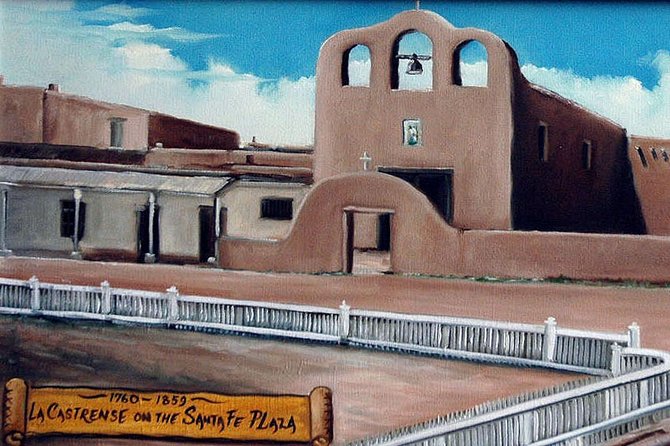
Santa Fe history starts at one Madonna. This longer-than-usual walking tour threads Spanish roots and modern Santa Fe through real landmarks, led by Ana Pacheco, a born-and-bred local historian. You get a paced walk across the Plaza area with stories that connect Native American, Spanish, Mexican, and American chapters of the city.
I especially like the private guide feel, even with a small max group size, because the pace stays flexible and you can ask questions. I also love how the tour builds a timeline you can feel, mixing art, architecture, and big historical moments right on the sidewalks around the Plaza.
One thing to plan for: not everything is included. Loretto Chapel is run as a privately owned museum, and its admission is not included, so you may want to budget extra if you plan to go inside.
In This Review
- Key highlights you will care about
- Start at the Cathedral Plaza, then trace 400 years fast
- Ana Pacheco and the style of guide you will appreciate
- Stop 1: Cathedral Basilica, La Conquistadora, and why the Plaza feels layered
- Stop 2: 109 East Palace and the Manhattan Project checkpoint
- Stop 3: Palace of the Governors, Pueblo connections, and Native American symbolism
- Stop 4: Loretto Chapel, Miraculous Staircase lore, and museum hours reality
- Stop 5: Burro Alley and the salt-and-saloon Santa Fe you can still feel
- Walking pace, timing, and what to bring
- Price and value for $80 with a small group
- Should you book Santa Fe Revisited?
- FAQ
- How long is the Santa Fe Revisited tour?
- What time does the tour start, and where does it begin?
- How much does it cost?
- Is the tour offered in English, and do I get a mobile ticket?
- Are admissions included at every stop?
- What is the cancellation policy?
Key highlights you will care about
- A longer walk for serious context, not just a quick look at photo spots
- Ana Pacheco guides the story with local street-level detail, and you will hear the city explained in plain terms
- WWII shows up in the Plaza area, including a stop at 109 East Palace tied to the Manhattan Project checkpoint
- Loretto Chapel and the Miraculous Staircase legend come with clear historical framing, including why the chapel is now a museum
- Burro Alley connects daily trade to nightlife-era Santa Fe, including the story of Doña Tules (María Gertrudis Barceló)
- Small group size (up to 10) helps keep questions in the loop without slowing everything down
Start at the Cathedral Plaza, then trace 400 years fast
This tour is built for people who want more than names and dates. You begin at the Cathedral Basilica of St. Francis of Assisi, right on Cathedral Place, and you work your way through the Plaza orbit. Along the route, the guide keeps turning the same core question in your mind: how did Santa Fe become Santa Fe?
You’ll hear the sweep of time laid out as a practical map. Native American presence, Spanish colonization, Mexican era change, and the later American period all show up in the buildings, church art, and even the street layout you walk past. The pacing also matters. At about 2 hours 15 minutes, it is long enough to connect the dots, but not so long that you feel stuck in place when you want a break.
One smart value here is that the tour keeps you oriented early in your visit. If you do this near the start of your trip, you will understand what you are looking at when you later return to the Plaza for shopping, food, or slow wandering.
Ana Pacheco and the style of guide you will appreciate
This experience runs with a single guide, Ana Pacheco, and the small max group size (10) helps keep the conversation real. What I like about this kind of local historian approach is that the stories do not feel lifted from a script. Ana is described as a true Santa Fe native with a deep personal investment in the area, and that shows in how she keeps shifting between big events and everyday detail.
From what you will experience on the walk, the guide also uses visual aids while moving, including pictures in a binder. That matters because a church façade or a mission wall can be hard to parse from street level. With the right images explained on the spot, you get to understand the style, the symbolism, and the purpose, not just the fact that something exists.
You should expect a guide who mixes humor with clarity. That combo helps when the tour covers multiple centuries in a compact route. And because it is offered in English, you can follow along without losing meaning in translation.
Not settled on one yet? These are other Santa Fe trips our reviewers have been through.
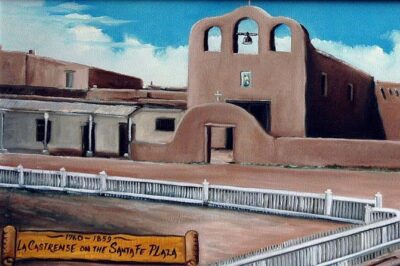
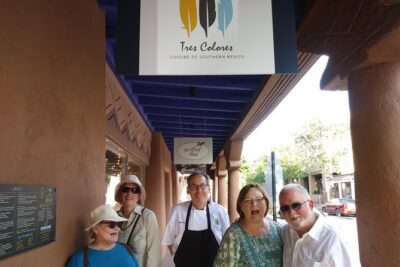
Stop 1: Cathedral Basilica, La Conquistadora, and why the Plaza feels layered
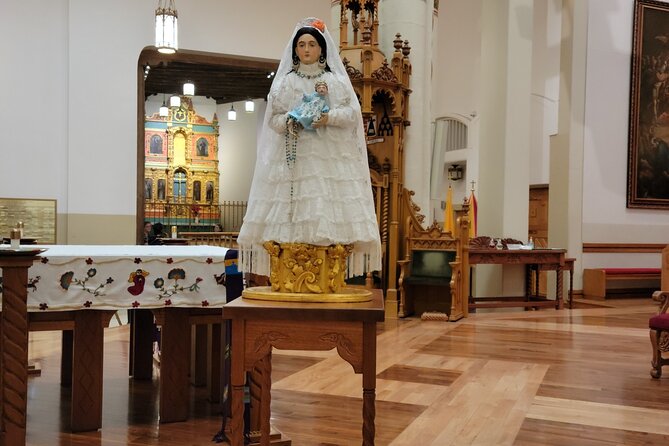
Your walk starts at the Cathedral Basilica of St. Francis of Assisi, a cornerstone stop in the Plaza area. This is where the tour’s time-travel feeling kicks in. One highlight tied to this stop is La Conquistadora, described as the oldest Madonna in the United States. You are not just hearing a trivia line. You are getting context for why that kind of religious art mattered in Santa Fe’s Spanish roots and how those influences stuck around.
From there, you get a broader look at the Plaza area as a hub of art and architecture. The guide connects what you see to how Santa Fe grew, including references to the Loretto Chapel and the San Miguel Mission church. The San Miguel Mission church is noted as the oldest in the country, and hearing that while you are standing in the orbit of the Plaza makes the claim feel real, not abstract.
A big value at this first segment is the framework. You will get an overview of about four hundred years of history, spanning Native American, Spanish, Mexican, and American influences. In practical terms, this helps you read the rest of the city with less confusion. Even if you are not a history person, this approach helps you understand why Santa Fe buildings and traditions look the way they do.
One note on access: the tour focuses on outdoor context and landmark introductions. You may find that some church interiors are not set up for guided entry, so think of this stop as a “see, understand, then decide” moment.
Stop 2: 109 East Palace and the Manhattan Project checkpoint
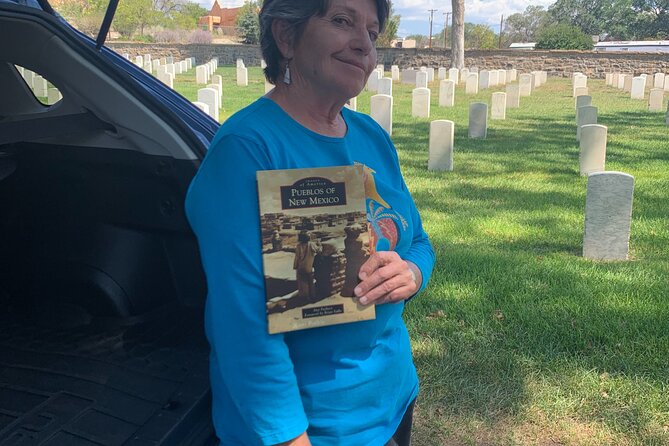
Then you pivot from earlier eras to something more sudden and modern. At 109 East Palace, you hear about a military checkpoint connected to the Manhattan Project during World War II. It is a surprising Santa Fe moment, and that contrast is part of the appeal.
I like this stop because it keeps the tour honest about what places do over time. Santa Fe is often framed mainly through Spanish and frontier imagery. But Santa Fe also sits inside national events, and this kind of stop tells you that the city’s story did not pause when the frontier closed.
From a traveler point of view, this moment also helps you with your own sightseeing choices later. When you see other plaques or government-related sites, you will know to ask, What was going on here at the time? That mindset turns random street corners into clues.
Admission here is listed as free, which makes it a low-cost way to add a major historical thread to your day.
Stop 3: Palace of the Governors, Pueblo connections, and Native American symbolism
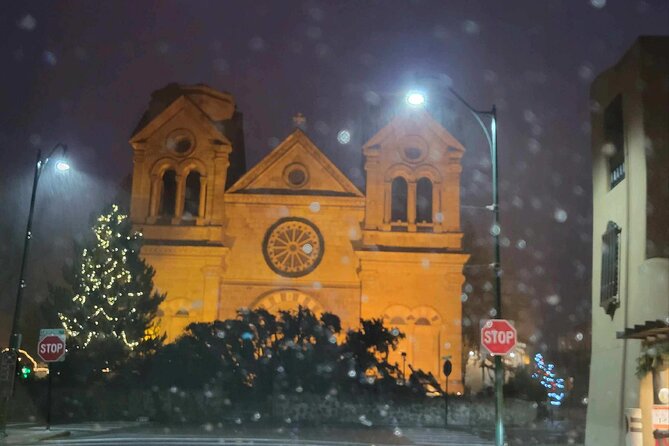
Next up is the Palace of the Governors, described as the oldest government building in the United States. Standing near it, you get the sense that this area is not just scenic, it is administrative history made visible.
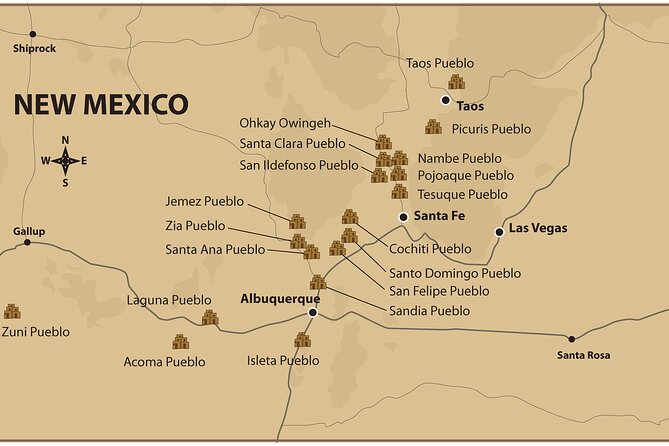
You will also get a Pueblo connection. The tour includes the history of New Mexico’s 19 Indian Pueblos. That topic can feel broad if you read it alone, but on a guided walk it turns into a clearer picture of how Native communities shaped the region’s identity and continuity. You are not only learning that pueblos exist. You are learning how they fit into the larger story of the state.
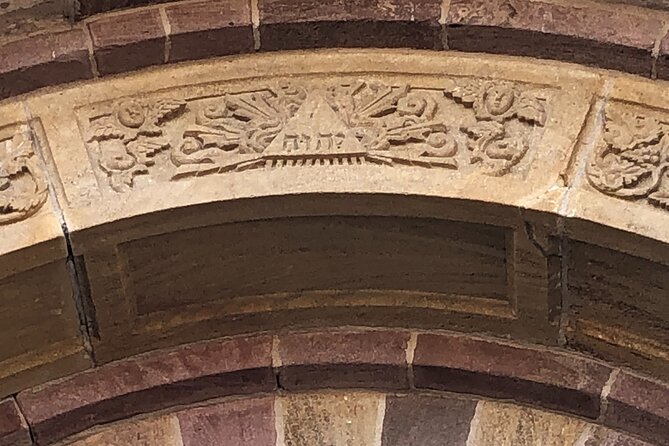
There is also a stop for a specific design story: the history of the only U.S. government building designed as a Native American symbol. That is the kind of detail that usually gets missed on casual visits. When you hear it while you are near the building, it becomes a “look for this” cue for your next glance around the façade and surroundings.
Admission for this portion is free, so you can focus on the explanation without worrying about ticket add-ons at this stage.
Stop 4: Loretto Chapel, Miraculous Staircase lore, and museum hours reality
Loretto Chapel is the emotional centerpiece for many visitors, and it comes with a set of stories you cannot easily get from the street. Built in 1878 by Archbishop Lamy to accompany the Sisters of Light Loretto Academy, the chapel is Gothic-Revival in style and is tied to European inspiration, including references to Saint Chapelle in Paris.
The tour also connects the chapel to architect Antoine Mouly, including his restoration work and how designs were patterned. You then land on the legend that matters most to many people: the Miraculous Staircase, described as a 360-degree staircase built between 1877 and 1881. The legend says it had no visible means of support. Today, it is known as the Miraculous Staircase associated with St. Joseph the Carpenter.
What I value here is that you get the full arc: the chapel was closed in 1968 and deconsecrated by the Catholic Church, and it is now run as a privately owned museum. That change is not just administrative. It affects how you experience the space now, and it helps explain why your visit may feel different than a church visit.
Here is the practical consideration: admission ticket is not included. If you plan to go in, expect an extra cost. Also, this stop is a good place to slow down. Even with a guided walk, this is the point where it helps to take your time reading the details and letting the staircase story land.
Stop 5: Burro Alley and the salt-and-saloon Santa Fe you can still feel
The final walk segment takes you down Burro Alley, a small street connecting Palace Avenue and San Francisco Street. It is easy to miss if you are just passing through, which is exactly why it is a perfect tour stop. The alley tells you how trade and daily routine shaped the town.
The story centers on vendors who sold salt from the Galisteo Salt Basin and firewood from surrounding mountains. While their burros rested, the vendors reportedly spent time in local saloons and brothels. That may sound like a colorful side note, but it actually connects to how an economy works, what people needed, and how rest spaces became social spaces.
You also get the name of María Gertrudis Barceló, known as Doña Tules, described as running a gambling hall at the corner near Palace Avenue. This is the kind of detail that makes an old alley feel alive, because you are picturing people making decisions and earning money in a real physical space.
This stop is listed as short, with no admission ticket. It is more about walking the line between what you see now and what used to happen here, and the guide makes that link easy to hold in your head.
Walking pace, timing, and what to bring
This is a walking tour, with a total duration of about 2 hours 15 minutes and a 10:00 am start. The route is focused on the Santa Fe Plaza area, so you will be moving at a human pace rather than rushing between distant neighborhoods.
It also runs only when weather is good. Santa Fe can shift quickly, so dress for comfort and think about a light layer even if the forecast looks friendly. You will be outside for multiple landmark stops, so shoes that handle pavement and possible uneven ground are worth it.
Because most of the listed admissions are free at the stops, the biggest potential “extra” is Loretto Chapel admission. Plan to decide on the spot based on how much you want to do inside that museum. If you like architecture legends and want to see the staircase setting, you will likely want to factor the extra cost in advance.
Service animals are allowed, and the tour is near public transportation, which makes it easier to fit into a day without needing a car for the entire outing.
Price and value for $80 with a small group
At $80 per person, this is not a budget-only walking tour. But it also is not priced like a multi-hour, far-flung excursion. The value here comes from three things you feel on the ground.
First, you get a long enough time slot to connect the landmarks to the larger timeline. A lot of shorter Plaza tours tell you what something is. This one also helps you understand why it matters.
Second, it is a small max group experience with a private guide feel. With up to 10 travelers, the guide can slow down when someone has a question or when a detail needs extra explanation.
Third, many stops are free to access by the tour’s structure, with the one notable exception being Loretto Chapel admission not included. So you are paying mainly for interpretation and pacing, not for repeated ticketing.
If you are doing Santa Fe in a limited number of days, this can be one of the better “one shot” investments. It sets your mental map so the rest of your sightseeing makes more sense.
Should you book Santa Fe Revisited?
Book it if you want Santa Fe explained like a story you can walk through. If you care about Spanish roots, church art and architecture, and the way Native and Mexican-era threads run through the city, this tour gives you a strong framework. It is also a smart first-tour choice, because it helps you return to the Plaza later with better context.
Skip it or adjust your expectations if you mainly want a quick scenic stroll, or if you would rather avoid any chance of added admission fees for Loretto Chapel. Also, because the tour requires good weather, you may want a flexible day in your schedule.
If you are the type who likes asking why a place looks the way it does, you will probably have a great time with Ana Pacheco’s approach, especially at the Cathedral, the WWII checkpoint stop, and the Miraculous Staircase story at Loretto.
FAQ
How long is the Santa Fe Revisited tour?
It runs about 2 hours 15 minutes.
What time does the tour start, and where does it begin?
The start time is 10:00 am. The meeting point is the Cathedral Basilica of St. Francis of Assisi at 131 Cathedral Pl, Santa Fe, NM 87501. The tour ends at San Miguel Chapel, 401 Old Santa Fe Trail, Santa Fe, NM 87501.
How much does it cost?
The price is $80.00 per person.
Is the tour offered in English, and do I get a mobile ticket?
Yes, it is offered in English, and you receive a mobile ticket.
Are admissions included at every stop?
Some stops list admission tickets as free, but Loretto Chapel’s admission is not included. Burro Alley also lists admission as not included.
What is the cancellation policy?
You can cancel for free up to 24 hours in advance for a full refund. If you cancel less than 24 hours before the start time, the amount you paid is not refunded.
Tour Reviews: more from our Santa Fe desk
- Santa Fe Ultimate History Walking Tour★ 5.0 · 516 reviews
- New Mexican Flavors Food Tour of the Santa Fe Plaza★ 5.0 · 466 reviews
- The ORIGINAL Wander New Mexico “Sip & Savor” Plaza Tour★ 5.0 · 337 reviews
Newest Santa Fe reviews added to this site
- The ORIGINAL Wander New Mexico “Sip & Savor” Plaza Tour
★ 5.0 · 337 reviews - Santa Fe Revisited
★ 5.0 · 415 reviews - New Mexican Flavors Food Tour of the Santa Fe Plaza
★ 5.0 · 466 reviews