
Review · CIVIL WAR BATTLEFIELDS
Gettysburg Battlefield Self-Guided Driving Audio Tour
Gettysburg hits harder when the audio guides you. This GPS-triggered self-guided driving tour turns key battlefield stops into a narrated story, with more than 60 audio chapters across a 19-mile auto route. I especially like the freedom to stop, park, read monuments, and start listening again on your schedule, and I also like that the tour is priced per car (up to 4 people) instead of per person. One consideration: the experience depends on your phone and car audio setup, and a few people run into audio sync or autoplay issues early on, so plan a quick troubleshooting moment rather than expecting perfection from minute one.
You can do it in about 2 to 4 hours, depending on how long you linger at overlooks and memorials. And since the tour is set up for offline use, you are not stuck hunting for bars while you are trying to park at Culp’s Hill or find the next story marker.
In This Review
- Key highlights you will feel fast
- Entering Gettysburg by auto road, not tour bus
- Price and value: $16.99 per group can be a steal
- How the app works, and why starting matters
- Getting sound right: phone setup for a smoother drive
- Heritage Center to McPherson’s Ridge: your Day 1 start
- Memorials and observation towers that turn driving into seeing
- Day 1 pacing: when evening signals the next chapter
- Day 2 highlights: Little Round Top and the “you are there” feeling
- Fields, orchards, farms: what makes Gettysburg readable
- Back into the woods: Spangler’s Spring to Culp’s Hill
- Gettysburg National Military Park and the Day 3 turning point
- The final stop: National Cemetery and Lincoln’s words
- What you can skip, and how to spend extra time
- Common hiccups: how to avoid audio sync problems
- Who this tour is best for
- Should you book the Gettysburg Battlefield driving audio tour?
- FAQ
- How long does the Gettysburg Battlefield self-guided driving audio tour take?
- Where do I start and end the tour?
- Is admission included for the first stop?
- Do I need cellular service to use the tour?
- How does the audio play while I drive?
- What if the audio does not work correctly?
- Can I cancel after booking?
Key highlights you will feel fast
- GPS location-based audio: the chapters play as you move through the route, so you focus on driving and looking, not tapping your screen nonstop.
- One ticket per vehicle: split the cost across a small group in your car for solid value.
- Offline maps and no-cell service needed: you can download once and then use it without cellular or Wi-Fi.
- Day-by-day battlefield flow: it moves from Day 1 to Day 3 in a way that helps the big picture click.
- Optional detour at Eisenhower National Historic Site: a quick add-on if you want another angle over the battlefield.
- Hands-free listening: audio plays automatically, and you can pause and resume when you get out.
Entering Gettysburg by auto road, not tour bus
This is not a bus tour, and that is the point. You drive your own vehicle, park where you want, and let the narration do the heavy lifting. For a place as packed with monuments as Gettysburg, the biggest win is that you can take your time at the stops that grab you, and skip the ones that do not.
The route is designed around the Gettysburg Battlefield Auto Tour road, with frequent “story moments” tied to memorials, ridges, observation towers, and key sites from all three battle days. Expect a lot of short stops, then a little driving, then another short stop, so your brain stays engaged instead of melting into one long lecture.
Price and value: $16.99 per group can be a steal
The price is $16.99 per group, up to 4 people, for this driving audio tour. That means the math works best when you have a small family or a couple traveling with another couple or two.
Compared with typical paid guided tours, the value comes from two things: you get a long route with 60+ narrated stories, and you can replay the tour later because access is lifetime with no expiry. If you are the type who likes re-watching a good documentary, or you are coming back to Gettysburg with more time, this format pays off.
Do not overpromise it on yourself, though. If you hate apps, or you dislike syncing your phone to your car speakers, then a guided tour might feel smoother. Here, the “product” is partly the tech experience.
The rest of our Guided notes for Gettysburg


How the app works, and why starting matters
After you book, you get an email and text with setup instructions and a password. You download the separate Action’s Tour Guide App onto your phone, and the tour is designed to work offline after the download. The important bit is timing: you must download while you have strong Wi-Fi or cellular.
On-site, you open the app and start the tour from the correct beginning point. The tour begins either at the Gettysburg Heritage Center or at the National Park Visitor Center, and the guidance follows the official auto route. There is no person meeting you at the start, so you are doing a quick self-check: app open, tour launched, and audio ready before you roll away.
When it runs well, you will not be babysitting the screen. The audio is location-triggered and hands-free, and it is meant to play automatically as you move between stops.
Getting sound right: phone setup for a smoother drive
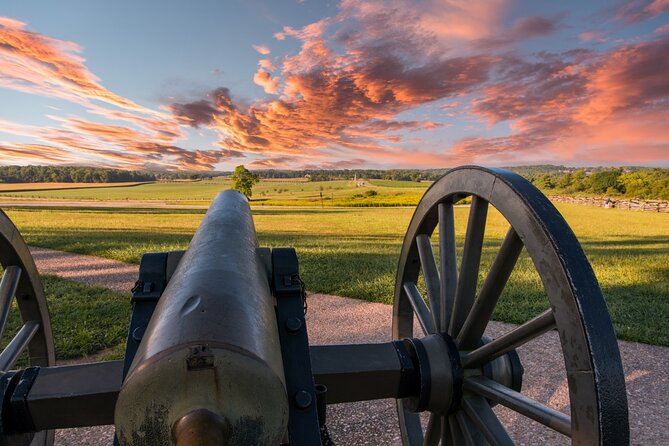
The tour supports different ways to play audio from your phone to your car. You can connect via Bluetooth, USB, or AUX, and audio playback is compatible with Apple CarPlay (navigation features are coming soon). Android Auto is listed as on the way.
Practical advice: if you plan to do more walking at stops like Little Round Top, use a headset for walking segments if that feels comfortable. Otherwise, you will probably hear less narration while you are scanning markers and reading plaques.
Also, match your phone permissions to your trip. The tour expects GPS to do its job, so keep location services on while you are driving the route.
Heritage Center to McPherson’s Ridge: your Day 1 start

Your first “anchor” stop is the Gettysburg Heritage Center. This is where you set context before the auto road turns into battlefield storytelling. One note that matters: admission to the museum is not included, so if you want to go inside and watch exhibits or browse the collections, plan extra time and budgeting.
From there, the tour follows the official Auto Tour route and starts Day 1 with the feeling of dawn breaking. At McPherson’s Ridge, you get the push and pull of Union and Confederate armies moving into position. This is where you start learning to read the ground: ridges are not just pretty views, they are how artillery, visibility, and cover shaped the fight.
Next you cross over the Railroad Cut. The narration here gives you a tactical angle, including the idea that this was an unlikely major skirmish site during the first day. It is a useful reminder that battles did not happen only at the famous “poster spots.”
Memorials and observation towers that turn driving into seeing
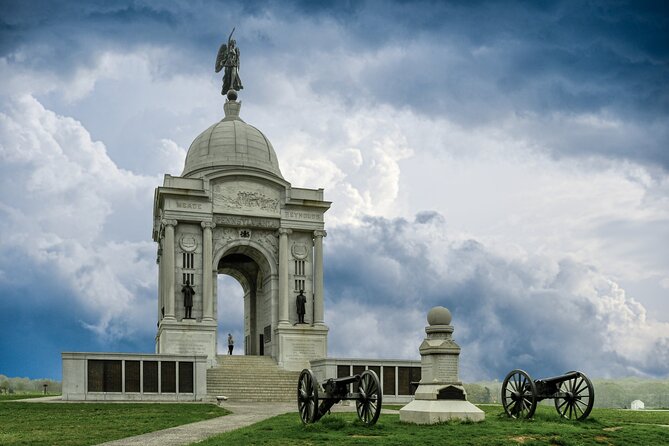
After the tactics, the tour shifts to memorial geometry and perspective. The Eternal Light Peace Memorial is one of the first major “meaning” stops, designed with Maine granite at the base and Alabama limestone in the pillar, representing reunification of the United States.
Then comes the Oak Ridge Observation Tower. If you only have time for one “look down and understand it” moment on Day 1, this is a strong candidate. From up top, you can grasp how the battlefield fields once supported so much movement and so much violence. You are not just sightseeing, you are training your eye to connect terrain to strategy.
You also pass the 11th Pennsylvania Volunteer Infantry Regiment Monument, including the famous dog statue at the base, Battlefield Sallie. That sort of personal detail is exactly why audio works well here: it adds human scale to stone, names, and formations.




Day 1 pacing: when evening signals the next chapter
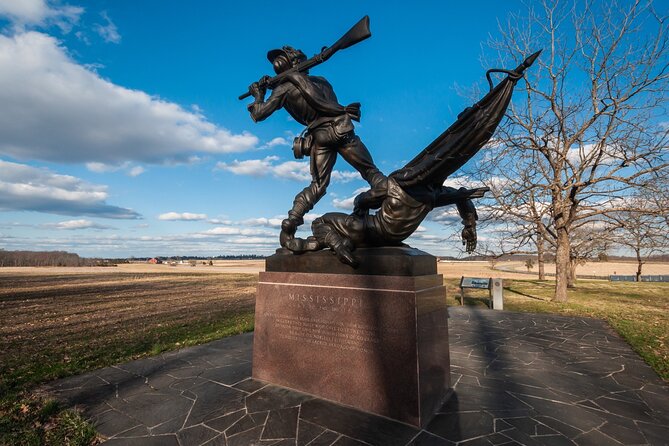
As the tour reaches evening on Day 1, the narration focuses on planning and setbacks. You will then move through memorial stops such as the North Carolina Memorial and the Virginia Monument area, with more of the battlefield story threading together behind the scenes.
One advantage of a driving audio tour is that you can keep rolling when you want motion, or slow down when a stop feels meaningful. You are not trapped in a schedule that insists you stay in your seat.
Day 2 highlights: Little Round Top and the “you are there” feeling

The tour continues into Day 2 at an auto road stop associated with the second-day opening movements. Here, troops organize and mobilize, and the narration helps you connect strategy choices to what you see on the ground.
Then the tour takes you past Longstreet Observation Tower, another viewpoint that helps you understand what commanders could see, and what they were trying to control. After that you have one of Gettysburg’s most talked-about areas: Little Round Top.
At Little Round Top, you hear the story of Union soldiers holding off Confederate troops on a critical hill. As you drive around the hill, you also cross the Valley of Death, which is a phrase you feel immediately after hearing the context and seeing how tight the terrain can feel when you picture movement under fire.
From the area near Devil’s Den, the narration highlights Confederate sharpshooters using volcanic rocks for cover. This is one of those moments where the audio gives you the “why,” and the rocks give you the “how.”
Fields, orchards, farms: what makes Gettysburg readable
As you keep moving, you pass the Wheat Fields and hear about the intense fighting tied to Day 2. You also get a story about Union soldier JJ Purman, which adds another personal layer to an otherwise huge and intimidating place.
Then come the Peach Orchard and the Abraham Trostle Farm. The Peach Orchard connects you to continued battles and the sense of momentum shifting toward or away from success. At the Trostle farm, the narration adds a striking detail: when fighting broke out, the Trostle family fled so abruptly that dinner was still on the table.
You also pass Plum Run and then the George Weikert Farm, where the family evacuated too, then returned to a grislier reality. This is where the tour leans into the medical side of the war, including what military doctors faced and the effects of battlefield conditions.
The State of Pennsylvania Monument provides a “stakes” moment. You are reminded that the nearly 35,000 Pennsylvanian soldiers here were fighting for their home state, not an abstract idea. It is an effective way to keep the story from staying only tactical.
Back into the woods: Spangler’s Spring to Culp’s Hill
As the route pushes deeper into the woods, you reach Spangler’s Spring. The narration explains why a small site can matter when you are dealing with thirst, supply, and the chaos of movement. Then you continue toward Culp’s Hill Tower, with the story centered on clashes as Union and Confederate soldiers fight for a strategic outpost.
By the time you reach East Cemetery Hill, night has fallen, and the narration covers a nighttime raid attempt and the near-loss moment for the Union. The important idea here is how close the outcome felt during a late-stage effort, and how the Union held on through perseverance, skill, and luck.
Gettysburg National Military Park and the Day 3 turning point
The tour then brings you to the Gettysburg National Military Park, framing the battle as a turning point that ended Robert E. Lee’s second invasion of the North. You also get the common framing of Gettysburg as the source of inspiration for Abraham Lincoln’s Gettysburg Address.
Then Day 3 arrives with the famous push: Pickett’s Charge. At the auto road stop connected to this moment, the narration positions you on the hill looking down at the empty expanse of the final battlefield. The concept of the high water mark, the farthest point the Confederacy advanced up the hill, gives your eyes a job to do besides admire stone and views.
The final stop: National Cemetery and Lincoln’s words
The tour ends at the National Cemetery. This is where you honor the graves of Union soldiers who defended their country and morals, and where Lincoln’s Gettysburg Address is associated with the site.
This stop is short in driving time but heavy in tone, and that is a good match for an audio tour finish. You do not need another long segment of driving to feel the weight of what you just saw. You just need time to stand there, read what you can, and let the story settle.
What you can skip, and how to spend extra time
This audio tour is designed so you can go at your own pace, and the self-guided setup supports pausing and resuming whenever you like. If you want a faster pass, you can keep each stop to the listed short time frames and move along the route in order.
If you want more impact, give yourself extra time for the observation points and for reading the memorials. Gettysburg is not a “drive-by” site if you want it to land. You might also use the chance to explore side areas when you park, since the format is flexible.
Common hiccups: how to avoid audio sync problems
Based on the way the tour is described, the most likely trouble spots are early on. If your phone is not in the right mode, or if GPS accuracy is off, the audio can start late, pause unexpectedly, or require a restart.
Here is how to reduce the odds:
- Start the app at the correct starting point (Heritage Center parking lot 297 or the designated Visitor Center option) and let the first story begin before you drive far.
- Stick to the suggested route and speed limit, because GPS location accuracy depends on your movement matching what the app expects.
- If audio does not play as planned, restart from the beginning and try again rather than continuing in a wrong sequence.
If you do run into persistent issues, the support option is described as contactable during set hours, so you are not left alone with no help.
Who this tour is best for
This works best for independent travelers who want a structured route but do not want the pressure of a strict group schedule. It is also a good fit for families with mixed interests, because the stops include both big landmark moments and smaller human details like Battlefield Sallie.
If you are the kind of visitor who likes to read plaques for 10 minutes at a time, this also fits your style. And if you want to control the pacing, the self-led format gives you that, without needing to book a guide.
On the flip side, if you want total simplicity and zero tech involvement, you might find a traditional guided tour more comfortable. The audio tour is flexible, but it asks you to manage your phone and car audio at least a little.
Should you book the Gettysburg Battlefield driving audio tour?
Book it if you want an affordable, structured way to see Gettysburg’s most important sites, with narration that gives meaning to what you are looking at. The biggest selling points are the GPS-triggered hands-free chapters, the per-car pricing, and the fact that you can return anytime due to lifetime access.
Skip it or switch formats if you are easily frustrated by app setup, you hate troubleshooting your phone in the car, or you need someone to manage the timing for you. Gettysburg deserves time, and this tour gives you it, as long as your tech is cooperating.
If you go, do this: download the tour on strong Wi-Fi first, connect your phone to your car sound before you start driving, and expect to spend extra time at the viewpoints and memorials. That is where the audio does its best work.
FAQ
How long does the Gettysburg Battlefield self-guided driving audio tour take?
It typically takes about 2 to 4 hours, and the route is noted as 19 miles long with more than 60 audio stories per tour.
Where do I start and end the tour?
You start at the Gettysburg Heritage Center parking lot (parking lot 297, Steinwehr Ave). The tour ends at 125 Taneytown Rd, Gettysburg, PA 17325. The tour also notes that the tour begins at either the Heritage Center or the National Park Visitor Center.
Is admission included for the first stop?
The Gettysburg Heritage Center admission ticket is not included. Other stops along the route are listed as free.
Do I need cellular service to use the tour?
No. The tour includes offline maps and is described as working perfectly without cellular or Wi-Fi after you download.
How does the audio play while I drive?
Audio stories are location-triggered and designed to play automatically based on your position. The tour is hands-free, and you can pause and resume when you stop.
What if the audio does not work correctly?
The tour notes that if you face audio issues, you can contact support. It also suggests that you should stay on the marked route and follow the speed limit for the best experience, since the GPS triggering depends on location accuracy.
Can I cancel after booking?
Free cancellation is available up to 24 hours in advance for a full refund. If you cancel less than 24 hours before the experience’s start time, the amount you paid is not refunded.
Guided reviewed right across Gettysburg
- 2-Hour Gettysburg Battlefield Guided History Bus Tour with a National Park Guide★ 4.5 · 2,201 reviews
- Gettysburg: Private Tour with Licensed Battlefield Guide★ 5.0 · 362 reviews
Tours: the rest of the Gettysburg file
- 2-Hour Gettysburg Battlefield Guided History Bus Tour with a National Park Guide★ 4.5 · 2,201 reviews
- Civil War Ghosts: Echoes of the Fallen Gettysburg Ghost Tour★ 4.5 · 913 reviews
- Gettysburg: Horse-Drawn Carriage Battlefield Tour★ 4.8 · 896 reviews
- Echoes of War All Ages Ghost Tour★ 5.0 · 658 reviews
- Gettysburg: Ghost Hunt Tour with Ghost Hunting Equipment★ 4.5 · 589 reviews
Tour Reviews: more from our Gettysburg desk
- 2-Hour Gettysburg Battlefield Guided History Bus Tour with a National Park Guide★ 4.5 · 2,201 reviews
- Civil War Ghosts: Echoes of the Fallen Gettysburg Ghost Tour★ 4.5 · 913 reviews
- Gettysburg: Horse-Drawn Carriage Battlefield Tour★ 4.8 · 896 reviews
- Echoes of War All Ages Ghost Tour★ 5.0 · 658 reviews
- Gettysburg: Ghost Hunt Tour with Ghost Hunting Equipment★ 4.5 · 589 reviews
Newest Gettysburg reviews added to this site
- Gettysburg: Private Tour with Licensed Battlefield Guide
★ 5.0 · 362 reviews - Ghost Tour: History and Haunts – Family Friendly – Best in Gettysburg
★ 4.5 · 378 reviews - Civil War Ghosts: Echoes of the Fallen Gettysburg Ghost Tour
★ 4.3 · 480 reviews - Gettysburg: Ghost Hunt Tour with Ghost Hunting Equipment
★ 4.5 · 589 reviews - Echoes of War All Ages Ghost Tour
★ 5.0 · 658 reviews - Gettysburg: Horse-Drawn Carriage Battlefield Tour
★ 4.8 · 896 reviews - Gettysburg Battlefield Self-Guided Driving Audio Tour
★ 4.5 · 910 reviews - Civil War Ghosts: Echoes of the Fallen Gettysburg Ghost Tour
★ 4.5 · 913 reviews - 2-Hour Gettysburg Battlefield Guided History Bus Tour with a National Park Guide
★ 4.5 · 2,201 reviews
Civil War Battlefields
 ★ 4.5Fort Sumter Admission and Self-Guided Tour with Roundtrip FerryFrom $433,343 reviews
 ★ 4.7Charleston: Fort Sumter Entry Ticket with Roundtrip FerryFrom $432,879 reviews
 ★ 4.52-Hour Gettysburg Battlefield Guided History Bus Tour with a National Park GuideFrom $432,201 reviews
 ★ 4.5Civil War Ghosts: Echoes of the Fallen Gettysburg Ghost TourFrom $32913 reviews
 ★ 4.8Gettysburg: Horse-Drawn Carriage Battlefield TourFrom $74896 reviews
 ★ 4.5Gettysburg: Ghost Hunt Tour with Ghost Hunting EquipmentFrom $28589 reviews
 ★ 5.0Civil War Tour with Lotz House, Carter House & Carnton Admission from NashvilleFrom $101522 reviews
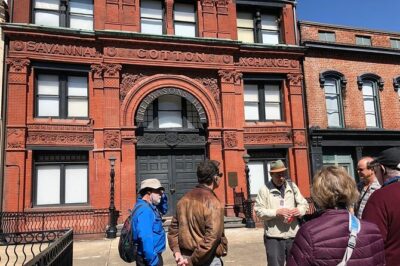 ★ 5.0Guided Savannah Civil War History Walking TourFrom $40492 reviews
This one is also listed in