

Review · ST. AUGUSTINE HISTORIC TOURS
Guided Historical Tour of St. Augustine Per Person
St. Augustine history, served fast. This guided historical tour uses a small open-air electric cart to carry you through the downtown core, so you can cover key sites in about an hour without wearing yourself out. You get personal Q&A time from the driver, who narrates the big moments that shaped this city from Spanish arrival onward.
What I like most is the small-group feel, capped at a maximum of 9 travelers. The other big win is how the guide turns landmarks into a story you can actually place on a map, especially with stops that connect the Mission Nombre de Dios era to forts, cemeteries, and later Flagler-era architecture.
One possible drawback: it runs in an open-air vehicle and depends on good weather. On cool or rainy days you may want layers, and on some departures you might appreciate extra warmth if the day turns breezy.
In This Review
- Key highlights at a glance
- Electric cart pacing: how 1 hour really feels in St. Augustine
- Meeting at 1 Cordova St and getting ready to roll
- Mission Nombre de Dios and the Shrine of Our Lady of La Leche
- Castillo de San Marcos: the fort that explains 450 years
- Cathedral Basilica and Tolomato Cemetery: faith and the older layers of time
- St. Francis Barracks: coquina walls and shifting empires
- Flagler-era architecture: Ponce de Leon, Flagler Memorial Church, and the design link to Venice
- Bridge of Lions and Plaza de la Constitución: where the city gathers
- The small-group feel: why guides like Karen Brady, Marc, and Deanna matter
- Price and value: is $30.60 per person worth it?
- Who should book this St. Augustine historical tour
- Should you book this guided St. Augustine historical tour?
Key highlights at a glance
- Small group size (up to 9) keeps the ride relaxed and questions easy
- Open-air electric cart helps you see more in about 1 hour than you would on foot
- Driver-guided storytelling ties together missions, forts, cemeteries, and plazas
- Major downtown stops include Castillo de San Marcos, the Cathedral Basilica, and Plaza de la Constitución
- Photo-friendly pacing with time to stop and look, not just pass by
Electric cart pacing: how 1 hour really feels in St. Augustine

The best part of this tour is the timing. St. Augustine’s historic center is compact, but traffic and crowds can make it feel like “short distances” turn into slow grinds. An open-air electric cart cuts through that stress. You still get sight stops, but you also get a steady rhythm, where the guide can explain what you are seeing before you move on.
Because the experience is about 1 hour (approx.), it works as your first move in town. After that hour, you’ll usually know which sites you want to slow down for later. That is a sneaky value add: you spend less time guessing and more time picking your next stops.
Also, the guide is the driver, which means you can ask questions on the fly without waiting your turn. It’s a simple setup, but it makes the tour feel more like a conversation than a lecture.
Meeting at 1 Cordova St and getting ready to roll
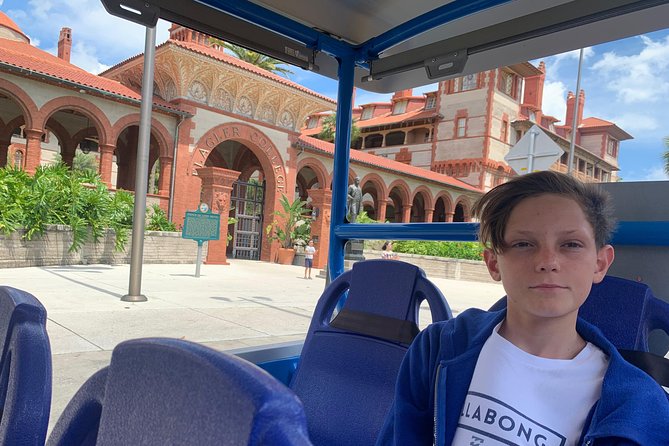
The tour starts at 1 Cordova St, St. Augustine, FL 32084 and ends back at the meeting point. That matters because it keeps the route tight around downtown, where most of the “must-see” history is clustered.
Plan for parking. The operator does not offer parking, so you’ll want to arrive early to secure a spot nearby. If you’re using public transportation, the meeting area is near transit, which is helpful if you are trying to avoid the whole parking chess game.
For day-of contact, check your ticket instructions for the phone number you can reach on the day of your tour. And yes, you’ll use a mobile ticket.
Finally, it’s designed for most travelers, with service animals allowed. And with a maximum of 9 people, you can expect the ride to stay intimate rather than crowded.
The rest of our Guided notes for St Augustine


Mission Nombre de Dios and the Shrine of Our Lady of La Leche
If you want the origin story of St. Augustine, this is where the tour starts steering that way. The stop at Mission Nombre de Dios includes the Shrine of Our Lady of La Leche, tied directly to the city’s founding.
Here’s the key historical anchor the guide will point you toward: on September 8, 1565, Pedro Menéndez de Avilés landed and proclaimed this site for Spain and the Church. Menéndez named the place Nombre de Dios, meaning Name of God. The mission also connects to Father Lopez, described as the first parish priest in St. Augustine.
What I like about this stop on an electric cart tour is that it gives you context before you stare at stone and signage. Instead of reading dates in a vacuum, you understand why this mission mattered in the early push to establish Spanish religious and civic life.
You may also hear the mission’s broader connection to the larger founding landscape. The tour references Menéndez founding the city at the Timucua village of Seloy, located at today’s Fountain of Youth Archaeological Park. Even if you are not walking that area in this particular hour, the mention helps you make sense of how the “new city” overlayed older Indigenous places.
Castillo de San Marcos: the fort that explains 450 years

Next comes the stop most history lovers circle: Castillo de San Marcos National Monument. This is where the guide’s storytelling really matters, because a fort can feel like just walls unless someone explains how those walls were used.
The tour frames Castillo de San Marcos as the oldest masonry fortification in the continental United States. It also highlights that the site interprets more than 450 years of cultural intersections. That phrasing is important. The fort isn’t presented as one straight national storyline. Instead, you are guided through the layers of power and trade that passed through this region.
You’ll likely get a clear sense of why the Spanish built it to defend Florida and the Atlantic trade route. And once you understand that purpose, you can look at the fort’s structure with more meaning, not just as a landmark you check off.
A practical note: if it is hot, this can be a spot where you may wish you had more time than one hour allows. But for a quick first visit, the cart tour does a smart job. You get enough to appreciate it now and decide later if you want the longer look on your own.
Cathedral Basilica and Tolomato Cemetery: faith and the older layers of time
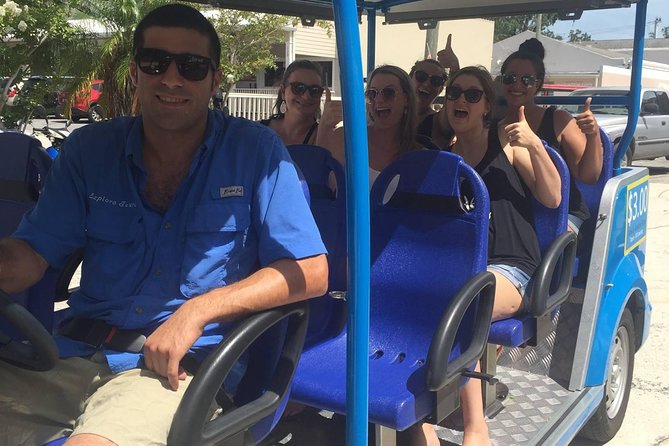
From forts and empire to sacred spaces and burial grounds, the itinerary moves you into two very different but deeply meaningful stops.
The Cathedral Basilica of St. Augustine is presented as the oldest Catholic Church in the city and also the oldest parish in the country. That is a big claim, and it helps you see why people care about this church beyond architecture. The guide’s narrative usually ties it into the earlier mission era, so the timeline feels connected rather than random.
Then you head to Tolomato Cemetery, described as the oldest European-founded city in the United States context, with use as a cemetery from the 18th century until 1884. Cemeteries are not everyone’s favorite stop, but this one lands well in a guided format. When a guide explains the context, it turns a cemetery from a quiet backdrop into an actual historical record.
If you’re sensitive to emotionally heavy places, plan to take it at your own pace. This is not a “party stop,” and it should not be forced. The benefit of the cart tour is that you can still keep moving afterward without losing momentum.
St. Francis Barracks: coquina walls and shifting empires
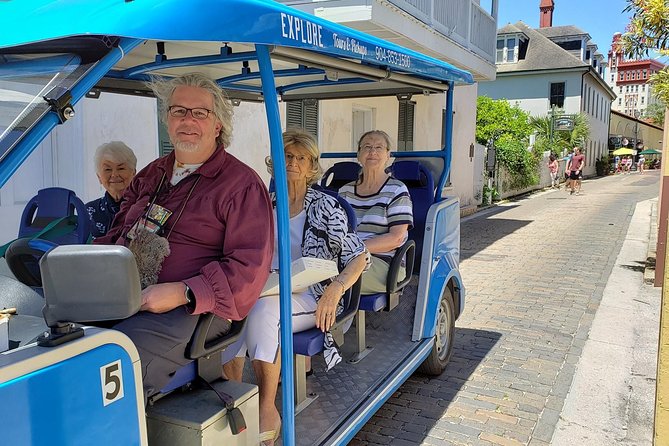
The tour also includes St. Francis Barracks, built of coquina between 1724 and 1755 by Franciscan friars. That material detail is the kind of thing that makes a guided stop worthwhile. Coquina is not just a building trivia fact. It helps you understand why the structure looks the way it does and why local resources mattered.
Then the story shifts to who controlled Florida. The barracks were converted for military use when Florida was possessed by the British in 1763. Later, in 1821, Florida is described as claimed by the United States, and the US Army took control until deactivation in 1900. After that, it was leased to Florida State Troops, the forerunner of today’s National Guard, in 1907.
That sequence of control is a lot for one hour, which is exactly why having a driver-guide matters. You’ll come away with a clearer sense of how this area changed hands over time, without needing to study a timeline book beforehand.
Also, the stop is short enough that you can still keep the day light. It’s a strong “history connector” stop that links the Spanish era to British and then American control.
Elsewhere under Historical Tours across St Augustine


Flagler-era architecture: Ponce de Leon, Flagler Memorial Church, and the design link to Venice
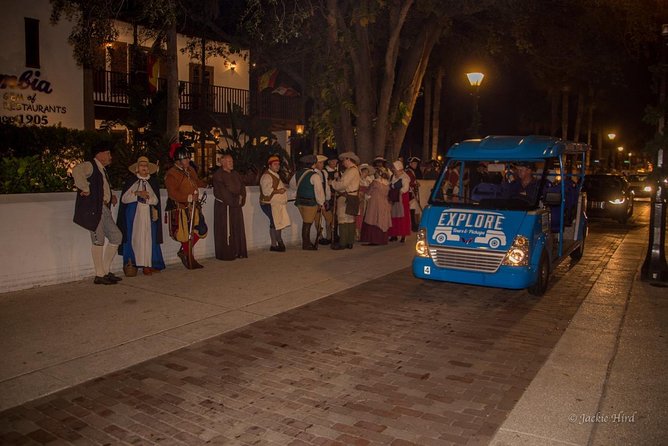
St. Augustine is not only Spanish-era. It also has this later wave tied to Henry Flagler, and the tour includes standout Flagler references.
You’ll pass the Ponce de Leon Hotel, now Flagler College. The tour highlights Flagler Memorial Presbyterian Church as well. That church was dedicated on March 16, 1890, and it is tied to Flagler’s daughter, Jennie Louise Flagler, who died in 1889. The old Presbyterian Church on St. George Street was vacated when the congregation moved to the new sanctuary with room for 480 worshipers.
Here is a design detail I’d keep in mind as you look around: Flagler chose the architects Carrere & Hastings, the same firm linked to the Ponce de Leon Hotel. The church’s design is said to be based on the Basilica of St. Mark in Venice. That connection is the kind of “why this looks like it does” tidbit that makes you see the building, not just walk past it.
The big benefit for you is perspective. If your only mental image of St. Augustine is colonial Spain, this part corrects that. You learn how the city’s identity kept evolving, even centuries after Menéndez’s landing.
Bridge of Lions and Plaza de la Constitución: where the city gathers
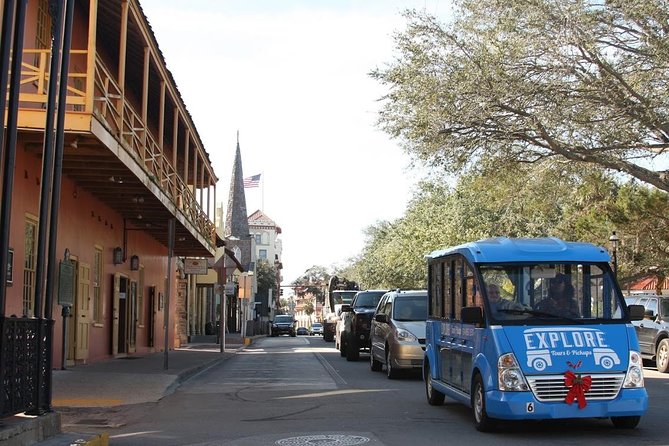
The tour also guides you to two very “St. Augustine in motion” stops.
The Bridge of Lions is described as completed in 1927, built during Florida’s land boom era. It connects downtown St. Augustine with Anastasia Island. The guide frames it as a work of art as much as a transport for cars, so it’s not just a crossing you forget. You’ll understand why it became a symbol, not only a route.
Then you end up at Plaza de la Constitución, the center of the historic city. The plaza is bordered by the Cathedral Basilica, Trinity Episcopal, and the Government House. The tour notes a central pavilion used for city events, private events, and live entertainment. There is also a public market on-site with a history of trading since the 1500s, when fish, vegetables, and other goods were sold here.
If you’re trying to plan the rest of your visit, this stop is handy. After the history tour, you often want a place to sit, grab a bite, and watch the city move. Plaza de la Constitución gives you that, plus the extra satisfaction of knowing how old the market tradition is.
The small-group feel: why guides like Karen Brady, Marc, and Deanna matter
A pattern shows up with this tour style: the guide is not just reciting facts. They do it in a way that invites questions and keeps the ride lively.
Names that come up include Karen Brady, Marc, Deanna, and Karen. They are described as warm, friendly, and ready to answer questions. You also get examples of guides stopping in front of different sites so you can hear them clearly, rather than racing past landmarks like a moving slideshow.
Another practical plus: pacing. Multiple guides are described as patient, allowing time to see sights and take photos. That matters when you are trying to capture details like cathedral facades, fort structure, or plaza energy.
Weather also plays into comfort. If it is drizzly, the experience is set up so the cart ride stays comfortable. On cool days, some guides have brought a blanket. So do yourself a favor and bring a light layer even if the forecast looks mild.
Price and value: is $30.60 per person worth it?
At $30.60 per person for about an hour, you’re paying for four things: a trained guide, a small group size, transportation through downtown, and an organized route that hits major historic points.
Is it expensive? In the world of tours, it is actually pretty reasonable, mostly because it saves you time. You avoid piecing together a DIY plan while you’re stuck in traffic or walking distances you do not need. You also avoid “I saw that” moments where you cannot remember what you just looked at.
For me, the best value is what the tour gives you after you dismount. This route helps you build a mental map. Once you know which places connect across time, you are more likely to return to the ones that truly pull you in, and skip the ones that do not.
Who should book this St. Augustine historical tour
This is a great fit if you:
- Want a strong first pass at St. Augustine history without a long day
- Prefer asking questions in real time
- Would rather ride than rush, especially in traffic
- Appreciate big-name landmarks with context that makes them easier to revisit
It may be less ideal if you love slow, long museum-style visits where you want to spend hours in one building. This tour is built for getting your bearings fast and choosing your next moves.
Also, it works well for couples, friends, and families who want a shared experience without a big group feeling. With a maximum of 9 travelers, you’ll likely feel like part of the group, not part of a crowd.
Should you book this guided St. Augustine historical tour?
Yes, if you want a practical, high-impact introduction to St. Augustine. This tour does what good history guides should do: it connects dates and places into a story you can follow while you’re actually looking at the sites. The small-group size, the driver-guide Q&A style, and the electric cart pacing make it a smart way to spend an hour in downtown.
If you’re traveling with limited time, this is one of the easiest ways to turn that time into real understanding. If you have extra time, take the tour first, then use it as your roadmap for deeper visits to the places that stick with you.
Guided reviewed right across St Augustine
- Private Guided Historic Electric Cart Tour of St. Augustine★ 5.0 · 1,194 reviews
- Airboat Adventure in Saint Augustine with a Guide★ 5.0 · 902 reviews
Tours: the rest of the St Augustine file
- St. Augustine Hop-On Hop-Off Trolley Tour★ 4.5 · 3,799 reviews
- St. Augustine Ghost Tour: A Ghostly Encounter★ 4.5 · 2,404 reviews
- Dolphin, Manatee and SeaTurtle SUP Adventure Tour of St Augustine★ 5.0 · 1,219 reviews
- Private Guided Historic Electric Cart Tour of St. Augustine★ 5.0 · 1,194 reviews
- Walking History Tour of St. Augustine’s Historic District★ 5.0 · 1,152 reviews
Tour Reviews: more from our St Augustine desk
- St. Augustine Hop-On Hop-Off Trolley Tour★ 4.5 · 3,799 reviews
- St. Augustine Ghost Tour: A Ghostly Encounter★ 4.5 · 2,404 reviews
- Medieval Torture Museum with Ghost Hunting and Tiny Art Gallery★ 5.0 · 2,011 reviews
- Take a Scenic Boat Ride in St. Augustine★ 4.5 · 1,399 reviews
- St. Augustine’s Wine, Cocktail and Food Experience★ 5.0 · 1,251 reviews
Newest St Augustine reviews added to this site
- St. Augustine Live Music Cruise with Drinks and Sunset Option
★ 5.0 · 315 reviews - Red Boat Tours – Dolphin Odyssey and Sightseeing Tour
★ 5.0 · 330 reviews - Feast of Saint Augustine Historical Walking Food Tour
★ 5.0 · 347 reviews - Nights of Lights Boat Cruise
★ 4.5 · 382 reviews - The Original Haunted Pub Tour
★ 4.5 · 382 reviews - Ghost Tour of St. Augustine: The Original Haunted History Tour
★ 5.0 · 386 reviews - Wine Tasting Cruise in St. Augustine
★ 5.0 · 426 reviews - Guided Historical Tour of St. Augustine Per Person
★ 5.0 · 470 reviews - 8pm Beyond the Grave Tour
★ 4.5 · 576 reviews - Old Jail Museum Tour in St. Augustine
★ 5.0 · 717 reviews
St. Augustine Historic Tours, side by side.
 ★ 4.5St. Augustine Hop-On Hop-Off Trolley TourFrom $383,799 reviews
 ★ 4.5St. Augustine Ghost Tour: A Ghostly EncounterFrom $302,404 reviews
 ★ 4.5Take a Scenic Boat Ride in St. AugustineFrom $261,399 reviews
 ★ 5.0St. Augustine’s Wine, Cocktail and Food ExperienceFrom $1591,251 reviews
 ★ 5.0Sunset Cruise of St. AugustineFrom $431,235 reviews
 ★ 5.0Private Guided Historic Electric Cart Tour of St. AugustineFrom $2001,194 reviews
 ★ 5.0Walking History Tour of St. Augustine’s Historic DistrictFrom $251,152 reviews
 ★ 4.6St. Augustine: Hop-on Hop-off Trolley Tour with Museum EntryFrom $39970 reviews
This one is also listed in