
Review · SAVANNAH HISTORIC DISTRICT
Heart of Savannah History Walking Tour – 2hr
Savannah history moves square to square. This 2-hour walking tour threads the city’s original plan, the big wars, and the characters that made it famous, then ends at Forsyth Park Fountain. I love how the guide connects the streets and squares to Oglethorpe’s founding idea, not just random facts. I also like the mix of serious history with fun pop-culture moments, especially the Forrest Gump stop.
The route is mostly outside viewing, so you keep moving, stay oriented, and get a feel for the historic district layout. One possible drawback: you cover a lot in a short time, with several quick stops, so if you want long questions at every location, you may feel a bit rushed.
Here’s what you should know before you choose this walk.
In This Review
- Key takeaways before you lace up
- Starting at Wright Square, the city’s design makes sense
- Gordon Monument and Tomochichi under your feet
- Juliette Gordon Low Birthplace, founder story without the fuss
- Independent Presbyterian Church and a steeple with a reason
- Chippewa Square and the Forrest Gump waiting moment
- Sorrel Weed House, gray-brick details, and a haunting mood
- Madison Square and the Siege of Savannah
- Green-Meldrim House and the cost of serious Gothic style
- Past SCAD and through a building story you might miss
- Gryphon Tea Room and Solomon’s Apothecary cabinet drama
- Midnight in the Garden ties the city to Jim Williams
- Armstrong-Kessler house for the wow factor, but it stays private
- Forsyth Park ends the walk with a photo plan that pays off
- Price and pace, what you get for your two hours
- What kind of traveler should book it
- Should you book the Heart of Savannah History Walking Tour?
- FAQ
- How long is the Heart of Savannah History Walking Tour?
- Where do I start and where does it end?
- Is the tour in English and do I get a ticket on my phone?
- Do we go inside any of the buildings?
- Does the tour run in bad weather?
- Are service animals allowed and can most people participate?
Key takeaways before you lace up

- Wright Square, Gordon Monument, and the 40-foot bluff story set the foundation for everything you’ll see next
- Forrest Gump filming location at Chippewa Square adds a fun, easy entry point to the city’s lore
- Movie and book connections show up later at the Mercer Williams house linked to Midnight in the Garden of Good and Evil
- Forsyth Park Fountain finale includes the mail-order from France detail, plus a perfect photo stop
- Most stops are free to view, so you’re paying mainly for a guide and your time, not ticket bundles
- Group size stays small-ish (max 30), which helps the pace and keeps the walking experience from feeling chaotic
Starting at Wright Square, the city’s design makes sense
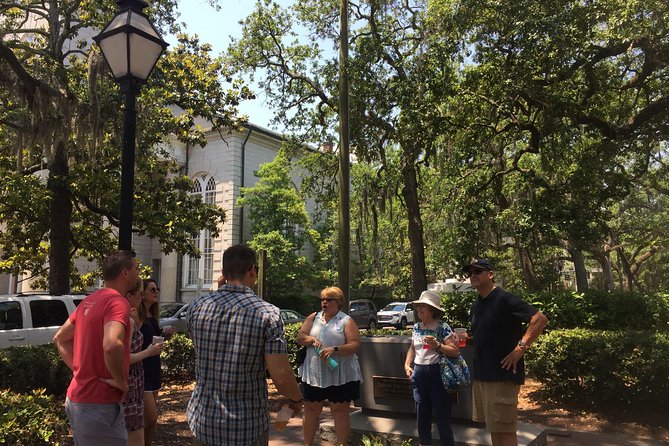
Your tour begins in the center of Savannah’s north side at Wright Square, right in front of the Gordon Monument. If you’ve ever felt overwhelmed by Savannah’s squares, this is the antidote. You get the why behind the layout, so later, when you wander on your own, the city feels planned instead of random.
The guide frames the whole story with the colony’s first choice of location. You learn about General James Oglethorpe and why he set up the colony on a 40-foot bluff, and you also hear how the squares are designed. That kind of context matters, because Savannah’s charm is not just buildings. It is the way the city was laid out to work and to signal order.
You’ll also get a few neat facts that help you picture Savannah as a real working city, not just a postcard. For example, you’ll hear that the Port of Savannah is the third largest port in the nation. That detail anchors the history in the present, and it makes your later stroll around town feel connected to today.
Gordon Monument and Tomochichi under your feet
At Wright Square, the Gordon Monument is your “read this first” stop. You learn who it connects to, and you also get the story of Tomochichi, the chief of the Yamacraw Indians, who is buried under the monument. It’s the kind of fact that makes you look twice at what seems like a simple statue.
You’ll also spend time on the square itself, including how and why it’s arranged the way it is. If you enjoy city planning, you’ll feel a small thrill here. Savannah’s public squares are not decorative extras, they are part of how the city functions.
The practical angle is this: once you understand the square logic, you can follow the historic district much more easily later. Even if you only remember one idea from this stop, remember this, the city’s structure is intentional.
Additional Walking Tours on the review pile in Savannah

Juliette Gordon Low Birthplace, founder story without the fuss
Next comes the Juliette Gordon Low Birthplace Museum. You admire her birthplace from the outside and learn that she was born October 31, 1860, and that she later founded the Girl Scouts. It’s a quick stop, but it adds a different layer to Savannah. This isn’t just war and architecture. It’s also leadership and civic influence.
One clear point to know: the tour does not go into the home. You spend your time looking at what’s visible from the street and learning from the guide’s story rather than walking through museum rooms. If you like a low-friction stop that still feels meaningful, this fits well.
Independent Presbyterian Church and a steeple with a reason
At Independent Presbyterian Church, you get a lesson in survival and rebuilding. The church’s story includes being founded in 1755 on Ellis Square, destroyed by fire, rebuilt on Telfair Square, and then destroyed by a hurricane. The church you see now sits on the corner of Bull St and Oglethorpe Ave, built in 1855.
There’s also a famous-sounding detail that you’ll learn on the walk: which U.S. president was married here in 1885. The tour also points out why this steeple is famous today. Even if you do not memorize the president’s name on the spot, you will likely remember the takeaway, Savannah’s architecture often carries long, complicated timelines.
This stop is brief, but it helps you see how often the city had to rebuild in its early years. That’s an important context for the whole tour, because so much of Savannah’s charm comes from layers, not one single era.
Chippewa Square and the Forrest Gump waiting moment
At Chippewa Square, the tour slides from serious founding story into pop-culture shorthand. You’ll see the spot where Forrest Gump sat with his box of chocolates, waiting for the bus. If you know the film, this stop is instantly recognizable. If you do not, it still works, because the guide ties the filming location into the city’s physical layout and famous monuments.
You’ll also get a small but useful correction. The monument in the middle of Chippewa Square is General James Oglethorpe, not Captain Morgan. The guide even acknowledges that it can be easy to mix them up visually. That little bit of humor is more than entertainment. It trains your eye to look at symbols and not just silhouettes.
Expect the guide to explain what Oglethorpe represents and why his monument matters here. This stop is about learning how Savannah marks its origin story in stone.
Sorrel Weed House, gray-brick details, and a haunting mood
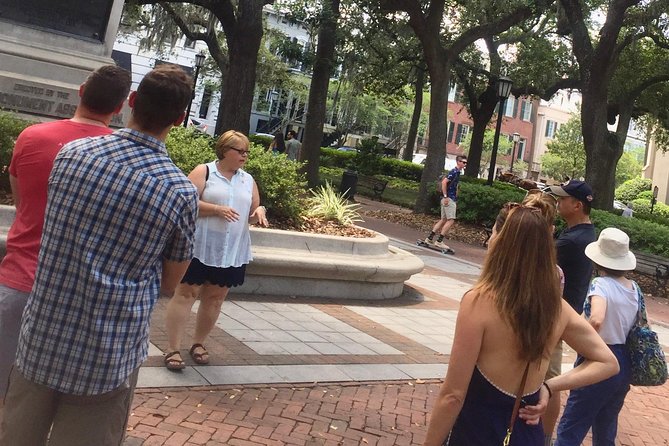
You then pass by The Old Sorrel Weed House Museum & Tours, described as one of the most haunted homes in Savannah. Even though you are not going inside on this walk, you still get a sense of why people talk about this place.
What I like about this stop is how it uses physical details to tell a story. You’ll hear about the gray brick wall surrounding the courtyard and the surprising mention of fingerprints in the brick, including the question of where that brick came from. That’s the kind of weird detail that makes the city feel human. Someone made those bricks. Someone worked those materials. That’s where the history sticks.
If you are not a fan of ghost stories, you can still treat it like an architecture and craft lesson, with a spooky side note. The guide’s delivery is what keeps it fun instead of heavy.
Elsewhere under Historical Tours across Savannah





Madison Square and the Siege of Savannah
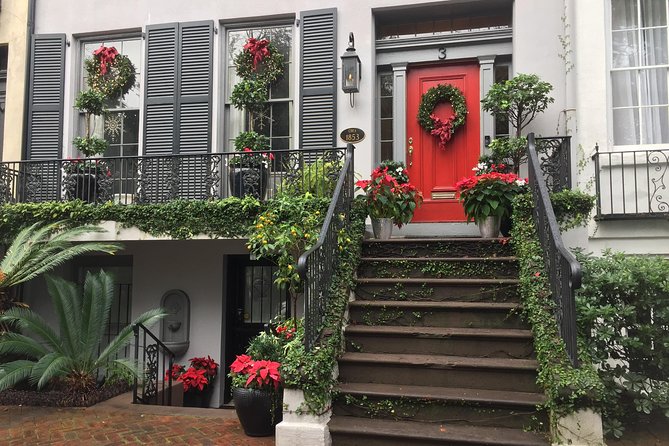
At Madison Square, the tour points to a Revolutionary War moment tied to the city’s brutal beginnings. The site where Madison Square stands today was once one of the bloodiest battles during the American Revolution, including the Siege of Savannah.
This is a stop where you get to connect the layout to events. Savannah’s squares are not just scenic; they were once strategic points in conflict. Even a quick stop like this can change how you see the whole district, because you start imagining movement through the city during wartime.
If you like history that feels grounded in geography, you’ll probably enjoy how the guide keeps pulling the story back to the street.
Green-Meldrim House and the cost of serious Gothic style
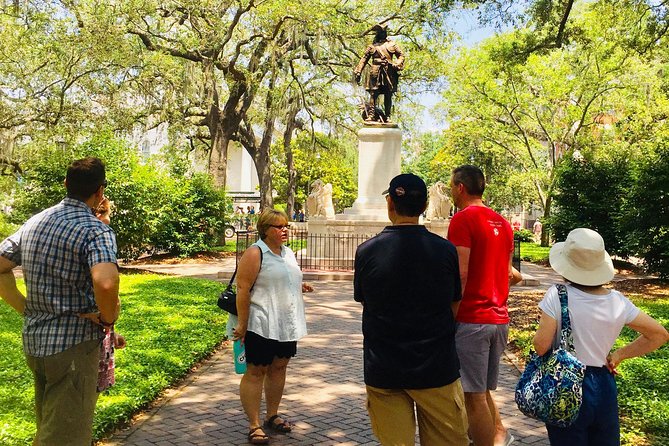
Next, you reach Green-Meldrim House, a standout architectural stop for anyone who likes old houses with real personality. The home was completed in 1853 and is described as one of the finest examples of Gothic architecture in the South.
You’ll also hear the cost story. The house cost $93,000, which the tour notes as about $3.2 million today, and it was the most expensive home in Savannah during the 1800s. That detail helps you understand why the house looks so intentional. This was money and status turned into brick and design.
Then comes a Civil War link. The home served as Headquarters for General Sherman during his March to the Sea, when he occupied Savannah. So this stop holds two different kinds of historical weight, style and conflict. The quick talk you get here sets you up to notice how architecture often signals power.
Past SCAD and through a building story you might miss
The tour then goes past a building originally used as the Savannah Volunteer Guard building, now owned by SCAD. This is a shorter, pass-by moment rather than an all-out explanation, but it’s still useful.
Why it matters is simple. Many people walk through Savannah looking at famous facades only. This kind of stop reminds you that institutions and repurposing are part of how the city survives. Even when you do not go inside, you get the sense that Savannah keeps changing, not freezing in time.
Gryphon Tea Room and Solomon’s Apothecary cabinet drama
Then you’re guided toward the Gryphon Tea Room, located inside what the tour calls the Shriner’s Building. Inside the tea room is a museum in itself tied to Solomon’s Apothecary, with original mahogany cabinetry and cubbies used for storing medicines.
Even if you do not plan to stop for tea, this mention is worth your attention. It gives you a practical next step for later in the day. You also get a good example of how Savannah preserves small, specific details, like cabinetry and storage units, that make the past feel tangible.
I like that the guide flags it as a favorite place to relax, whether you want lunch, dinner, or just a break. This is one of those moments that helps you turn a walking tour into a full-day plan.
Midnight in the Garden ties the city to Jim Williams
After that, the walk highlights the Mercer Williams house, the one made famous by Midnight in the Garden of Good and Evil by John Berendt. The tour connects the book to the true story of Jim Williams, who purchased the home in 1969, and the shooting of his assistant Danny in 1981.
You’ll also hear the publication impact. The book released in 1993 spent 216 weeks on the New York best seller list, longer than any book in history, according to the tour details. Then the film release helped put Savannah on the tourism map even more.
The guide recommends that you read the book or at least watch the movie before you visit Savannah. I agree with that approach because it gives you story context, and it makes the house feel less like a random mansion and more like a set piece from a real event.
Armstrong-Kessler house for the wow factor, but it stays private
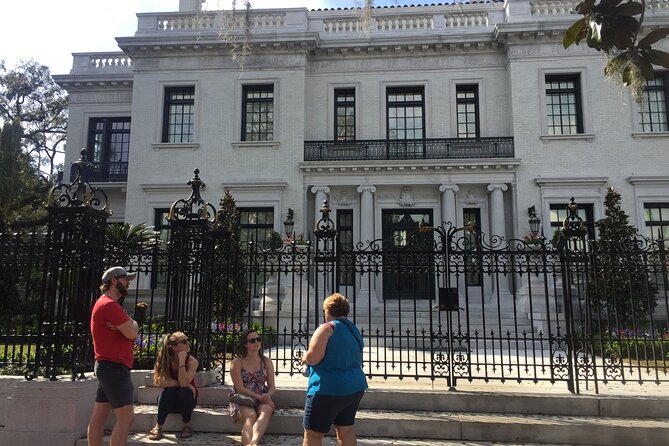
One of the most impressive architectural moments comes at Armstrong House, now known as the Armstrong-Kessler house. The tour talks about its history and who lives in the home today, and it calls it the one home in town where people often stop and say wow.
Here’s the practical catch: it is a private home and not open for tours. That means you should treat this as a curbside admiration stop. You still get the story, but you do not get interior access.
If you love exterior details and want the city’s grand-scale houses without adding museum time, this works well. If you specifically want inside access, plan other stops on your own.
Forsyth Park ends the walk with a photo plan that pays off
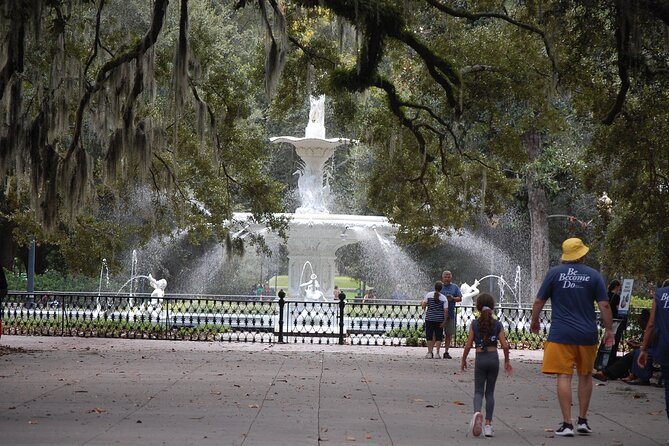
Your tour finishes in Forsyth Park, and it’s a smart ending. This park began in 1848 as 10 acres and today covers 30 acres. It’s Savannah’s central gathering place for young and old alike, and the guide points you to the big landmark at the heart of it.
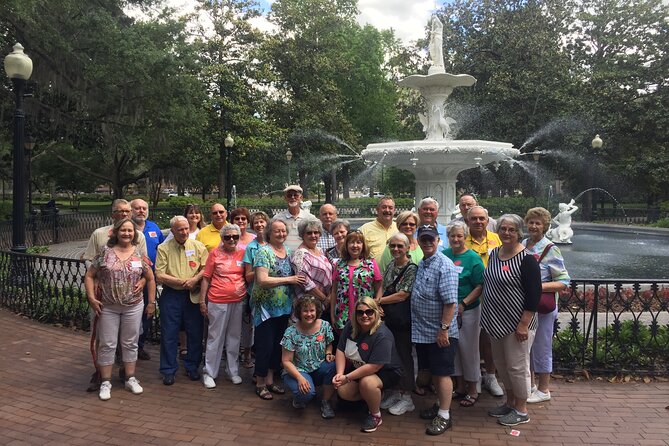
The crown jewel is the Forsyth Park Fountain. The tour highlights the detail most people miss: the fountain was a catalog mail order from France and installed in 1858. That’s the kind of fact that makes your photo feel more meaningful than just a backdrop.
You get a short final stop with time to take pictures and soak in the open space after the tight walking route. It’s a good reset before you head to your next meal or wander farther into the district on your own.
Price and pace, what you get for your two hours
There is no single price listed here, but the value is easy to see from the structure. Most stops are marked as free admission ticket moments, meaning you’re paying for a guide’s explanations and the efficient route through multiple historic points.
Time is the trade-off. This is an approx two-hour walk with several stops around major squares and notable sites. That means the tour works best if you treat each stop as a highlight, not a deep research project. If you want extra time at one location, you can always plan to return later once you know where your interests are.
The walking is described as about one mile with benches along the way. Still, Savannah can feel warm and humid in summer, and the tour notes that you should bring water and consider the weather, including an umbrella. If you’re planning this during peak heat, early morning is a good way to keep the walk pleasant.
What kind of traveler should book it
This tour is a strong fit if you want a fast start and an easy mental map of Savannah’s historic district. It also suits people who like storytelling that mixes big events, like the American Revolution and Civil War era references, with smaller human details.
It’s also a good pick for visitors who enjoy movie or book connections. The Forrest Gump moment at Chippewa Square and the Midnight in the Garden ties at the Mercer Williams house give you two entry ramps into the city’s identity.
If you are sensitive to fast pacing, you may want to go into it with the right expectations. Several sites are outside or pass-by, and the rhythm is designed to keep you moving from square to square and finish at Forsyth Park.
Should you book the Heart of Savannah History Walking Tour?
I think you should book this tour if you want an efficient, guided orientation that links Savannah’s layout to real events and real people. The mix of founding stories, war-era context, architecture, and pop-culture stops makes it easier to stay interested from start to finish.
Skip it only if you strongly prefer inside museum time at every stop or you need a slower pace with lots of lingering. This walk is built for a smooth two-hour overview, and it rewards you most when you plan to explore further on your own afterward.
FAQ
How long is the Heart of Savannah History Walking Tour?
The tour is about 2 hours. The walking portion is described as approximately 1 mile, with benches along the way.
Where do I start and where does it end?
The tour starts in the center of the north side of Wright Square in front of the Gordon Monument. It ends at Forsyth Park, specifically at the fountain.
Is the tour in English and do I get a ticket on my phone?
Yes, the tour is offered in English. You receive a mobile ticket.
Do we go inside any of the buildings?
Some stops are outside viewing only. For example, you admire the Juliette Gordon Low Birthplace from the outside, and the Armstrong-Kessler house is a private home not open for tours. Other stops are passed by or viewed from the street, such as the Sorrel Weed House and the Volunteer Guard building.
Does the tour run in bad weather?
The tour operates rain or shine. In severe weather, you are given an option to reschedule. You are not told about refunds in those cases except in the note that you would be offered a different date or a full refund if the tour is canceled due to poor weather.
Are service animals allowed and can most people participate?
Service animals are allowed. The information also says most travelers can participate, with guidance to wear comfortable walking shoes and consider heat and humidity, especially in summer.
Still working through Walking Tours in Savannah
- Savannah History and Haunts Candlelit Ghost Walking Tour★ 5.0 · 3,235 reviews
- Savannah First Squares Culinary & Cultural Walking Food Tour★ 5.0 · 3,229 reviews
- Historic Savannah Guided Walking Tour★ 5.0 · 2,918 reviews
- Savannah’s Ghost City “Dead of Night” Walking Night Tour★ 4.5 · 2,482 reviews
- Southern Flavors Food, Pub Crawl, and History Walking Tour★ 4.5 · 1,623 reviews
Tours: the rest of the Savannah file
- Savannah Hop-On Hop-Off Trolley Tour★ 4.5 · 6,527 reviews
- Savannah History and Haunts Candlelit Ghost Walking Tour★ 5.0 · 3,235 reviews
- Savannah First Squares Culinary & Cultural Walking Food Tour★ 5.0 · 3,229 reviews
- Historic Savannah Guided Walking Tour★ 5.0 · 2,918 reviews
- Savannah Ghosts & Gravestones Trolley Tour★ 4.0 · 2,723 reviews
Tour Reviews: more from our Savannah desk
- Savannah Hop-On Hop-Off Trolley Tour★ 4.5 · 6,527 reviews
- 90-Minute Savannah Riverboat Sightseeing Cruise★ 4.0 · 3,367 reviews
- Savannah History and Haunts Candlelit Ghost Walking Tour★ 5.0 · 3,235 reviews
- Savannah First Squares Culinary & Cultural Walking Food Tour★ 5.0 · 3,229 reviews
- Historic Savannah Guided Walking Tour★ 5.0 · 2,918 reviews
Newest Savannah reviews added to this site
- Civil War Savannah!! Guided Walking Tour
★ 4.0 · 314 reviews - Welcome to Savannah Guided Walking Tour
★ 5.0 · 329 reviews - Historical Bike Tour of Savannah and Keep Bikes After Tour
★ 5.0 · 345 reviews - Savannah Stroll: Guided Sightseeing & History Walking Tour of Savannah
★ 4.5 · 350 reviews - Golf Cart Tours, Bonaventure Cemetery Savannah Cruzers
★ 5.0 · 356 reviews - Savannah: Tybee Island Dolphin Tour
★ 4.7 · 359 reviews - 90-Minute Segway History Tour of Savannah
★ 5.0 · 365 reviews - Savannah Yes, Queen! Drag Queen Pub Crawl
★ 4.5 · 367 reviews - Savannah Midnight in the Garden of Good & Evil Narrated Walking Tour
★ 5.0 · 370 reviews - Narrated Harbor Luncheon Riverboat Cruise
★ 4.5 · 371 reviews
Savannah Historic District, side by side.
 ★ 4.5Savannah Hop-On Hop-Off Trolley TourFrom $446,527 reviews
 ★ 4.090-Minute Savannah Riverboat Sightseeing CruiseFrom $413,367 reviews
 ★ 5.0Savannah History and Haunts Candlelit Ghost Walking TourFrom $393,235 reviews
 ★ 5.0Savannah First Squares Culinary & Cultural Walking Food TourFrom $963,229 reviews
 ★ 5.0Historic Savannah Guided Walking TourFrom $302,918 reviews
 ★ 4.0Savannah Ghosts & Gravestones Trolley TourFrom $392,723 reviews
 ★ 4.5Savannah’s Ghost City “Dead of Night” Walking Night TourFrom $342,482 reviews
 ★ 4.5Narrated Historic Savannah Sightseeing Trolley TourFrom $352,375 reviews
This one is also listed in