
Review · TROLLEY AND SEGWAY CITY RIDES
Salt Lake City Trolley Tour with 3 Theatrical Guides & Live Show
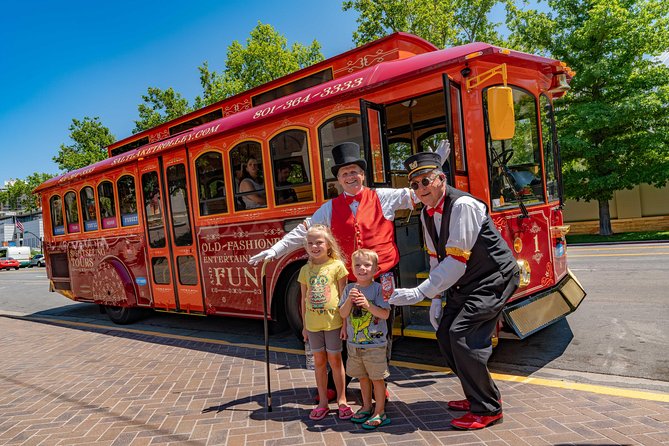
History rolls by with three actors on a trolley. This Salt Lake City Trolley Tour pairs three theatrical guides with a live show on wheels, so you get city orientation without boring, one-note narration.
I love how the cast stays friendly, professional and keeps the tone upbeat with jokes, songs, and clear facts. I also love the all-in price feel, since taxes and fees are included and admission at the main stops is free. The main tradeoff is time, the trolley gives you great glimpses, but you will have only short stays at many locations.
In This Review
- Key highlights you should care about
- Why this trolley tour works when you only have a short window
- Price, value, and what you actually get for $69
- How the ride is paced, and why that helps families and first-timers
- The show format: three guides, music, and role-playing that sticks
- Stop 1: Utah State Capitol and why the views are part of the lesson
- Stop 2: Cathedral of the Madeleine and what to expect from a short interior visit
- Stop 3: Mormon Battalion Monument, short stop, strong story
- Stops 4 and 5: Temple Square and the Salt Lake Temple silhouette that ties it together
- Stop 6: The Salt Lake Tabernacle and the engineering behind the sound
- Stop 7: Conference Center, 21,000 seats, and modern precision
- Stops 8 to 13: Civic power, Brigham Young’s era, and the downtown “people versus temples” theme
- City and County Building (Stop 8)
- Beehive House (Stop 9)
- City Creek Center (Stop 10)
- Salt Lake City Public Library (Stop 11)
- Governor’s Mansion (Stop 12)
- Council Hall (Stop 13)
- Stops 14 to 18: Downtown sports, the Gateway, and genealogy on a massive scale
- Delta Center (Stop 14)
- Joseph Smith Memorial Building (Stop 15)
- The Gateway (Stop 16)
- FamilySearch Library (Stop 17)
- FamilySearch Center (Stop 18)
- Stops 19 to 24: Church headquarters, land markers, and the oldest surviving home feel
- Church Office Building (Stop 19)
- Washington Square (Stop 20)
- Eagle Gate (Stop 21)
- Brigham Young Monument and Meridian Marker (Stop 22)
- Salt Lake Masonic Temple (Stop 23)
- Deuel Pioneer Log Home (Stop 24)
- Who should book this trolley tour, and who should think twice
- Should you book the Salt Lake City Trolley Tour with 3 Theatrical Guides?
- FAQ
- How long is the Salt Lake City trolley tour?
- How much does the tour cost?
- What is included with the ticket price?
- Do I have to pay for admission at the stops?
- Where does the tour start and where does it end?
- Is free cancellation available?
Key highlights you should care about

- A live “show-tour” format: you are not just riding and listening, you are watching history performed.
- Three-guide chemistry: different personalities cover different chapters of Salt Lake City’s story.
- Photo-stop pacing: quick looks at lots of landmarks, plus a couple of places where you can get off longer.
- Free admission at key stops: you are not adding extra ticket costs as the tour rolls along.
- Trolley treats included: old-fashioned bottled sodas and Cracker Jacks, plus music on wheels.
- A tight downtown loop: ideal if you want big hits of Salt Lake City in about 2 hours.
Why this trolley tour works when you only have a short window
If you are new to Salt Lake City, the hard part is not the sights, it is figuring out how they connect. This trolley tour strings together the capital, the church landmarks around Temple Square, and the civic and modern downtown buildings into one easy storyline.
The “show-tour” concept matters because it lowers the mental load. You do not need to plan routes or read a guidebook for context, the guides build the links for you as you pass each location.
Price, value, and what you actually get for $69
At $69 per person for roughly 1 hour 30 minutes to 2 hours, the price can feel like a splurge until you look at what is bundled. The tour includes sightseeing tour guides, three theatrical entertainers, and a musical sightseeing show on wheels.
You also get trolley treats, old-fashioned bottled sodas and Cracker Jacks, which is a small thing but makes the ride feel like an event. Best of all, the total price includes taxes, fuel surcharges, and service fees, so you are not stuck recalculating the real cost later.
What else we logged under City Tours in Salt Lake City
How the ride is paced, and why that helps families and first-timers
The route is built around quick visits, then photo stops, then a bit more walking where it matters. That is why this tour works for families, couples, and even solo travelers who want a quick orientation without committing to a half day.
The tour runs with a maximum of 27 travelers, so it does not feel packed like some big bus tours. In recent feedback, people also called out practical comfort details like good airflow and snacks, plus a restroom break.
The show format: three guides, music, and role-playing that sticks
A normal narrated tour can blend together. Here, you get a cast of three theatrical guides, and the style is built to help you remember what you heard, not just passively absorb it.
A common pattern is performance plus explanation. The guides step into different voices and story angles, then tie those scenes to the buildings you are seeing. In past tours, guests even named standout pairings like Anna and Matthew, Matthew and Kelly, and Shayla and Luke, along with the musical element.
If you like humor in small doses and songs that move the story forward, this is the right format. If you want strict, quiet museum pacing, this may feel a little campy, since the point is to make history entertaining.
Stop 1: Utah State Capitol and why the views are part of the lesson
Your first big landmark is the Utah State Capitol, completed in 1916. From the outside, it looks like an architectural announcement, and the tour uses that first impression well.
You get a real payoff here: time to experience the building up close and take in the terrace views over the valley and the Wasatch Mountains. Inside, the guides connect Utah’s politics, ambition, and statehood story to sculptures, murals, and the grand rotunda, so it is not just a photo stop.
If you care about architecture, this is often the anchor stop, because the Capitol is dramatic and its setting is part of the meaning.
Stop 2: Cathedral of the Madeleine and what to expect from a short interior visit
Next is the Cathedral of the Madeleine, a Gothic Revival church completed in 1909. Even with a brief visit, it can hit hard because it combines soaring arches, carved stone, and stained glass into a single visual package.
The guides focus on faith, art, and the determination behind building a sanctuary on the frontier. You’ll see painted murals and ornate altar details, and the tone here is more reflective than comic.
One practical consideration: in some seasons, there can be construction around the area, which may limit how much you see from certain angles. If that happens, stay flexible and prioritize getting inside and looking up.


Stop 3: Mormon Battalion Monument, short stop, strong story
The Mormon Battalion Monument is a quick pass, but the story behind it is big. It honors 500 pioneers who marched nearly 2,000 miles from Iowa to California during the Mexican-American War.
What makes this stop work is how the guides frame it as endurance and conviction, not trivia. You are positioned amid wider views from Capitol Hill, and that open setting helps the monument feel less like a plaque and more like a moment in Utah’s larger narrative.
Stops 4 and 5: Temple Square and the Salt Lake Temple silhouette that ties it together
Then you hit Temple Square, the spiritual heart of Salt Lake City. From the trolley, you can see the gates and gardens, plus the scale of the ten-acre site chosen by Brigham Young in 1847.
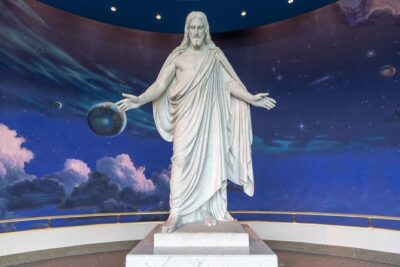
At the center is the Salt Lake Temple. The tour emphasizes its long build time, hand-carved granite, and six spires, plus the idea that the city’s skyline is shaped by faith and labor. You do not go inside, since the temple is closed to the public, but you do get the “why” behind what you are looking at.
Even if you are not religious, this is one of the most important Salt Lake City orientation stops. It explains the city’s geography, not just its buildings.
Stop 6: The Salt Lake Tabernacle and the engineering behind the sound
The Salt Lake Tabernacle is famous for acoustics, and the tour makes that tangible. Completed in 1867, it uses a domed roof spanning 150 feet without interior pillars.
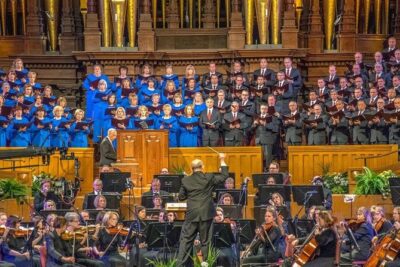
The guides also tie it to ingenuity and community pride, and you’ll hear why the space is known for hearing sound clearly. The Tabernacle Choir association is part of the aura here, and the tour treats the building like a living piece of performance history.
Stop 7: Conference Center, 21,000 seats, and modern precision
From the older Tabernacle, you go to the Conference Center, completed in 2000. This is the visual and functional contrast: a modern auditorium seating 21,000 people.
The tour highlights how the building is engineered for clear voice carry, so your ears understand the design even if you only see it from the trolley. A rooftop garden and cascading waterfalls add a calmer layer, so it does not feel like a sterile arena.
Stops 8 to 13: Civic power, Brigham Young’s era, and the downtown “people versus temples” theme
This part of the tour shifts into civic Salt Lake City, and it is where you start to see the city’s political drama written into stone and brick.
City and County Building (Stop 8)
You get a quick look at the City and County Building, completed in 1894. It looks like a castle and was once Utah’s first state capitol, so it helps explain how government competed for grandeur near the temple spires.
Beehive House (Stop 9)
Then comes the Beehive House, built in 1854, once home to Brigham Young. The honeybee carvings connect the building to values like industry and cooperation, and the guides frame it as both family home and executive center.
City Creek Center (Stop 10)
You also pass City Creek Center, opened in 2012, which is a downtown reinvention story. It has retractable glass roofs, fountains, and a real trout-filled stream flowing where pioneers once drew water.
This is a smart stop for anyone who thinks Salt Lake City is stuck in the past. It shows how the city layers modern style over older water and settlement lines.
Salt Lake City Public Library (Stop 11)
The library is next, a five-story glass arc designed by Moshe Safdie and completed in 2003. The tour points out the wave-like form around a sunlit plaza and how the rooftop garden and reading rooms turn a library into a public gathering space.
If you love design, this is one of those “just look up” moments.
Governor’s Mansion (Stop 12)
The Governor’s Mansion, built in 1902 for mining magnate Thomas Kearns, adds an elegant Gilded Age flavor. The guides talk about lavish parties early in the city’s growth and how it survived fire and restoration.
Council Hall (Stop 13)
Council Hall is red brick and Greek Revival, built in 1866 as Utah’s first territorial capitol. It connects to big debates like polygamy and women’s suffrage, and you’ll hear the dramatic detail that it was moved brick by brick in 1963 to save it from demolition.
This stop works because it turns a simple building into a political record.
Stops 14 to 18: Downtown sports, the Gateway, and genealogy on a massive scale
After the courthouse-and-mansion run, the tour lands on modern landmarks that show Salt Lake City reinventing itself again and again.
Delta Center (Stop 14)
You pass the Delta Center, home of the Utah Jazz since opening in 1991. Even outside, it feels like energy because the tour connects it to NBA action, concerts, and Olympic figure skating.
If your trip overlaps with an event, this stop will make you want to check schedules.
Joseph Smith Memorial Building (Stop 15)
Next is the Joseph Smith Memorial Building, originally the Hotel Utah, opened in 1911 for presidents, movie stars, and big-name travelers crossing the West. The white terracotta facade and Beaux-Arts style are the visual hook.
The Gateway (Stop 16)
Then you glide past The Gateway, built as a welcoming center for the 2002 Winter Olympics. You’ll see restored brick depots, Olympic monuments, and mountain views, with fountains and art around an outdoor plaza.
This is the tour’s “modern Salt Lake fun” interlude, without losing the historical thread.
FamilySearch Library (Stop 17)
The FamilySearch Library is billed as the world’s largest collection of genealogical records. The tour frames Utah’s role in preserving family history at scale, and it connects that idea to pioneers who treated lineage as legacy.
FamilySearch Center (Stop 18)
It continues with another FamilySearch-related exterior look, again reinforcing the idea that family history is not just old documents, it is also connected to modern technology and global access.
Stops 19 to 24: Church headquarters, land markers, and the oldest surviving home feel
This final stretch is about symbols and “place meaning,” from tall corporate HQ to early survival structures.
Church Office Building (Stop 19)
The Church Office Building is 28 stories of marble and glass, completed in 1972. The guides connect it to worldwide reach, and the location near the temple makes the contrast in scale impossible to miss.
Washington Square (Stop 20)
Washington Square is a compact overview of power and architecture again, with Washington Square crowned by the City and County Building. The tour uses the rivalry theme, civic versus spiritual influence just blocks apart.
Eagle Gate (Stop 21)
Eagle Gate is one of the city’s earliest landmarks, first built in 1859 as an entrance to Brigham Young’s property. You’ll see the bronze eagle spread across more than 20 feet, and the guides explain how it shifted from a farm entrance to a unity symbol between pioneer past and modern city.
Brigham Young Monument and Meridian Marker (Stop 22)
At the crossroads downtown, you get the Brigham Young Monument plus the Meridian Marker, the point from which Utah land surveys begin. This is a fun stop because it turns abstract geography into something you can point to on the map.
Salt Lake Masonic Temple (Stop 23)
The Masonic Temple built in 1927 adds a different community thread. The neoclassical facade and grand columns hint at the rituals and symbols inside, and the tour connects early Freemasons to civic foundations.
Deuel Pioneer Log Home (Stop 24)
The closer is the Deuel Pioneer Log Home, one of Salt Lake’s earliest surviving structures from 1847. The tour emphasizes hand-hewn local timber and the everyday grind of building homes from scratch.
This final stop tends to land best when you are ready to slow down. After all the monuments and spires, a small, real log home gives the whole story a human scale.
Who should book this trolley tour, and who should think twice
Book it if you want a fast, entertaining way to learn Salt Lake City without running from museum to museum. It is especially strong for first-timers, families with mixed ages, and anyone who learns better through stories and performance than through lectures.
You might think twice if you plan to spend hours inside major buildings or want a deep, quiet tour style. This is a highlight ride. You see a lot, you hear a lot, but you do not get museum-length time for every stop.
Should you book the Salt Lake City Trolley Tour with 3 Theatrical Guides?
If your goal is a solid orientation plus a memorable show, I think this is a good buy. For $69, you are paying for more than transport, you are paying for narrative plus music plus a tight loop of major landmarks like the Capitol, Temple Square, the Tabernacle, and modern downtown hits like City Creek Center and The Gateway.
If you are picky about time inside each site, plan on using this as your “first pass” tour, then return later on your own to any building that really grabs you.
My call: book it if you want energy, laughs, and clear context in about two hours. Skip it if you want quiet depth at only a few places.
FAQ
How long is the Salt Lake City trolley tour?
It runs about 1 hour 30 minutes to 2 hours (approx.).
How much does the tour cost?
The price is $69.00 per person.
What is included with the ticket price?
You get three theatrical entertainers and sightseeing tour guides, trolley treats (old-fashioned bottled sodas and Cracker Jacks snacks), and a musical sightseeing show on wheels.
Do I have to pay for admission at the stops?
Admission tickets for the listed stops are free, and the tour includes what you need for those visits.
Where does the tour start and where does it end?
The tour starts at Radisson Hotel Salt Lake City Downtown, 215 W S Temple St, Salt Lake City, UT 84101. It ends back at the meeting point.
Is free cancellation available?
Yes. You can cancel for a full refund up to 24 hours in advance of the experience’s start time. If you cancel within 24 hours, the amount you paid will not be refunded.
City Tours: what else we logged in Salt Lake City
- Salt Lake City Guided Bus Tour★ 4.5 · 1,355 reviews
- Tabernacle Choir Performance + Salt Lake City Guided Bus Tour★ 4.5 · 597 reviews
Tours: the rest of the Salt Lake City file
- Salt Lake City Guided Bus Tour★ 4.5 · 1,355 reviews
- 45 Minute Great Salt Lake Boat Tour★ 4.5 · 829 reviews
- Tabernacle Choir Performance + Salt Lake City Guided Bus Tour★ 4.5 · 597 reviews
Tour Reviews: more from our Salt Lake City desk
- Salt Lake City Guided Bus Tour★ 4.5 · 1,355 reviews
- 45 Minute Great Salt Lake Boat Tour★ 4.5 · 829 reviews
- Tabernacle Choir Performance + Salt Lake City Guided Bus Tour★ 4.5 · 597 reviews
- Great Salt Lake Wildlife Experience★ 5.0 · 392 reviews
Newest Salt Lake City reviews added to this site
- Salt Lake City Trolley Tour with 3 Theatrical Guides & Live Show
★ 5.0 · 527 reviews - Tabernacle Choir Performance + Salt Lake City Guided Bus Tour
★ 4.5 · 597 reviews - 45 Minute Great Salt Lake Boat Tour
★ 4.5 · 829 reviews - Salt Lake City Guided Bus Tour
★ 4.5 · 1,355 reviews
Trolley and Segway City Rides, side by side.
 ★ 4.5Savannah Hop-On Hop-Off Trolley TourFrom $446,527 reviews
 ★ 4.5Nashville Hop On Hop Off Trolley TourFrom $535,643 reviews
 ★ 4.5Boston Hop-On Hop-Off Trolley Tour with 13 StopsFrom $525,576 reviews
 ★ 4.5Waikiki Trolley Hop-On Hop-Off Tour of HonoluluFrom $224,783 reviews
 ★ 5.0Waikiki Trolley Blue Line Coastline & Local Grindz Hop-on Hop-offFrom $354,159 reviews
 ★ 4.5St. Augustine Hop-On Hop-Off Trolley TourFrom $383,799 reviews
 ★ 5.0Newport Gilded Age Mansions Trolley Tour with Breakers AdmissionFrom $473,785 reviews
 ★ 4.51 or 2 Day HOP-ON & HOP-OFF Narrated Trolley Tour of BostonFrom $482,849 reviews
This one is also listed in