
Review · HISTORICAL TOURS
American Museum of Natural History Admission Ticket
Dinosaurs and space in one massive stop. This AMNH admission ticket is a simple way to spend real time with one of New York’s best museum powerhouses, from 13-billion-year universe stories to world-famous halls.
What I like most is the full-day freedom. The ticket is built so you can wander at your own pace instead of racing between rooms. I also love how the museum mixes iconic, show-stopping specimens (like the T. rex skeleton) with hands-on science areas that work for adults and kids alike. One consideration: because this is voucher-based, you may still need to swap it for an entry ticket, and that exchange can mean extra standing around if the line is long.
In This Review
- Key things to know before you go
- What the AMNH admission pass really includes
- Price and value: is $37 worth it?
- Ticket swap, entry flow, and getting oriented fast
- The dinosaur moment: Hall of Saurischian Dinosaurs and T. rex scale
- Akeley Hall for mammals: Asian elephants with real gravitas
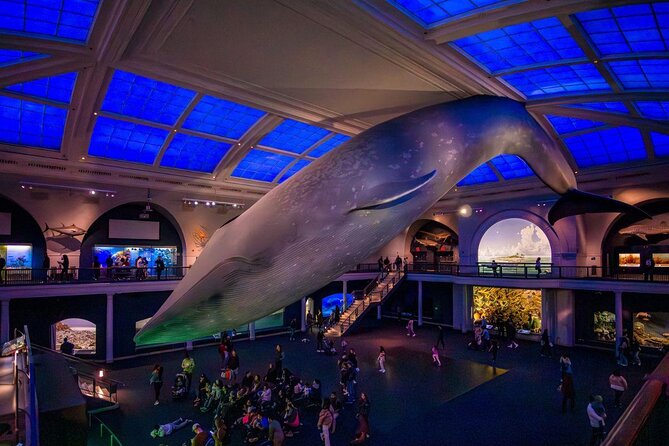
- Ocean Life theater: Milstein Hall and the 29-meter blue whale model
- Rose Center and the Gilder Center: science beyond animals
- What you might miss unless you plan for ticketed extras
- Pacing a 3 to 4 hour plan without feeling rushed
- Crowds, closed exhibits, and how to protect your day
- Who this ticket fits best
- Should you book this AMNH admission ticket?
- FAQ
- How long should I plan for at the American Museum of Natural History?
- What is included with general admission?
- What is not included in general admission?
- Do I need to exchange my voucher for a ticket?
- Is this admission ticket good for families and kids?
- Is the museum easy to reach and can I get a map on site?
- Can I cancel for a full refund?
Key things to know before you go

- 40+ permanent galleries, plus access to the Rose Center for Earth and Space and the Richard Gilder Center
- Icon hall hits: T. rex in the Hall of Saurischian Dinosaurs, Asian elephants in Akeley Hall, and a 94-foot (29-meter) blue whale model in Milstein Hall
- Plan at least 3 hours, but the museum can easily eat more time since it spans multiple levels
- Not everything is included: some ticketed experiences cost extra (like certain planetarium shows and special exhibitions)
- Voucher to ticket exchange can add waiting time at the entrance if you hit a busy moment
- Family-friendly setup with stroller and ADA-friendly navigation, plus food options including gluten free choices
What the AMNH admission pass really includes
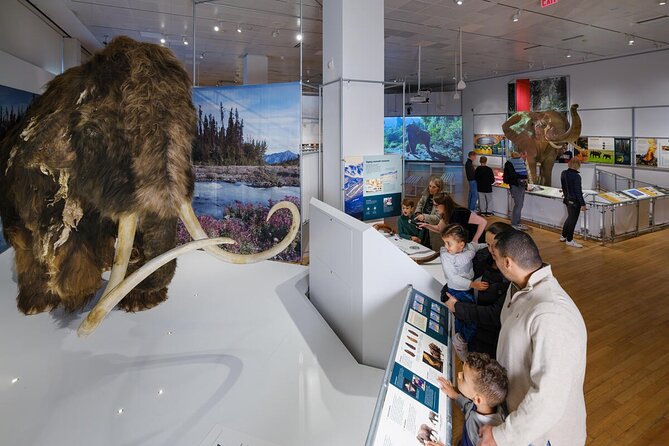
This ticket is straightforward: you’re paying for general admission to the American Museum of Natural History on the Upper West Side. Once you’re in, you have access to more than 40 permanent exhibition galleries, along with the Rose Center for Earth and Space and the Richard Gilder Center for Science, Education, and Innovation.
In practice, that means you can build a visit around your interests instead of following a fixed route. You can go from the big universe questions to dinosaurs, then pivot to animals, minerals, oceans, and back to science galleries. If you’re traveling as a family, this “choose your own sequence” setup helps everyone have at least a few wins.
Also, the museum is large and it’s easy to get turned around. Good news: you can pick up a paper map at the museum entrances and information desks. Take it early, mark the rooms you care about, and you’ll spend more time looking and less time guessing.
Price and value: is $37 worth it?
At $37 per person for general admission, you’re buying time. And AMNH is one of those places where time is the real currency.
If you treat it like a checklist, 40+ galleries can feel rushed fast. That’s why the visit is often described as a 3 to 4 hour experience on average. If you’re smart about pacing, that range can work. But if you stop for details, take photos, or travel with kids who want to repeat their favorite room, you’ll likely want more.
Where the value comes in:
- You’re getting multiple anchor areas, not just one wing or one theme.
- The included halls cover the stuff people actually talk about after the trip, like dinosaurs and ocean life.
- The museum’s scale means you can spread your time across levels without paying extra per room.
If you’re the type who hates crowds and hates lines, then your “real cost” is time spent waiting for a voucher swap. But if you can handle a little logistics and you’re planning a full museum day, $37 can feel like a bargain.
More from our Tickets coverage in New York City


Ticket swap, entry flow, and getting oriented fast
This is not just a one-step “scan and go” ticket in the moment. The experience is voucher-based, so you’ll need to convert your voucher into an admission ticket on site.
Here’s how to make that smoother:
- Arrive early enough that you’re not fighting peak rush.
- Have your confirmation details ready so the swap goes quickly.
- Grab the paper map right away so you don’t waste your first hour trying to find the next must-see.
A couple of practical realities from the experience notes:
- The museum has strong public transport connections, so you don’t have to build your whole plan around parking.
- The museum can get busy, and when that happens, the ticketing exchange becomes the speed limit for your day.
Tip: if your group includes kids under 3, that age group qualifies for waived admission fees, which can help you plan smarter around costs.
The dinosaur moment: Hall of Saurischian Dinosaurs and T. rex scale

AMNH is famous for dinosaurs, and the Hall of Saurischian Dinosaurs is one of the key reasons. If you want the classic “wow” entry point, this is it.
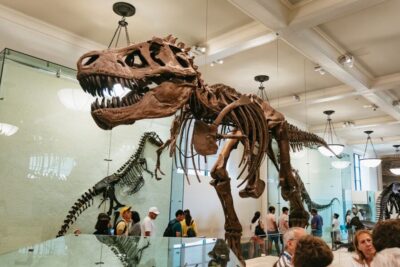
You’re going to see the Tyrannosaurus Rex skeleton, and the impact is less about the name and more about the scale. Standing near a skeleton that size changes how you think about prehistory. It also gives you a natural anchor for the rest of the visit. After you’ve seen the big icon, the smaller fossil displays feel more meaningful because you already “buy in” to the museum’s time scale.
Potential drawback: this is a high-demand area. If you’re visiting during busier periods, expect some crowding around the main displays. If your group is stroller-friendly, you’ll still be able to move, but you may need patience while people cluster for photos.
Akeley Hall for mammals: Asian elephants with real gravitas
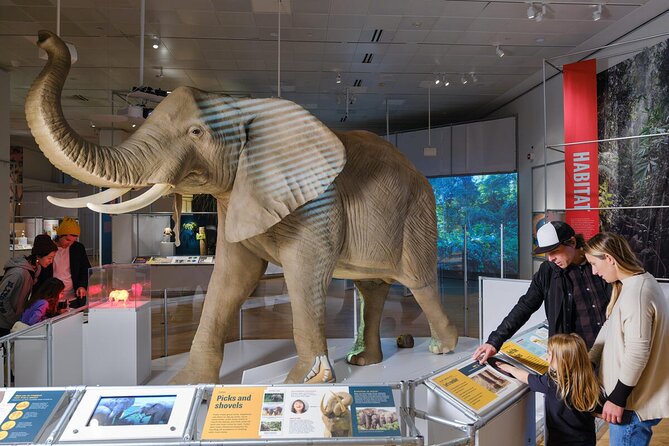
Next up is animal life, and Akeley Hall is a standout. If you want one “feel it in your bones” stop, make it the exhibit with Asian elephants.
What works so well here is the museum’s approach to animal storytelling. You’re not just looking at background information, you’re looking at the animals themselves, with enough presence that kids naturally lean in. For adults, it’s a chance to reconnect with how museums communicate through scale and specimen display, not just text.
Why this matters for your day:
- It’s a mental reset from dinosaurs and space.
- It helps families keep momentum because animals are usually a universal hit.
Consideration: you may want to avoid long detours if your group’s energy is limited. The museum is huge, and you’ll do best when you give each “big section” a specific amount of time instead of wandering endlessly.
Ocean Life theater: Milstein Hall and the 29-meter blue whale model
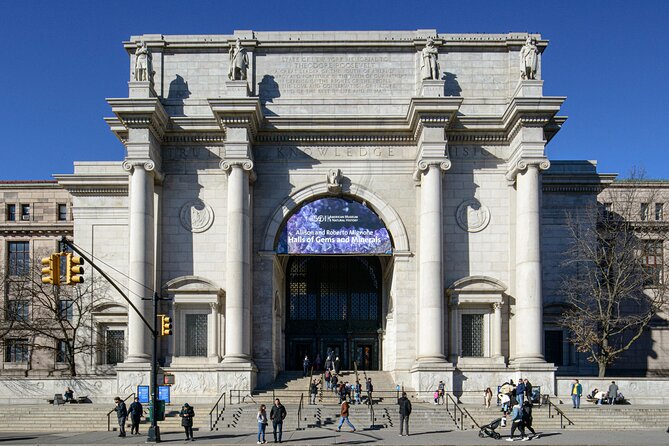
Then comes one of the most eye-filling exhibits at the museum: the blue whale model in Milstein Hall of Ocean Life. The model measures 94 feet (29 meters) long.
This stop is pure payoff. Even if you know basic facts about whales, seeing the scale in person makes it feel new again. It’s the kind of moment that works for couples, families, and anyone who likes nature without turning it into a lecture.
If you’re planning photo stops, this is a good one to prioritize early. Crowds gather here because it’s hard to miss and hard not to photograph. If the line gets slow for your group, you can also treat this as a “quick hit” for the whales and then move on to smaller ocean displays while your group still has energy.
Elsewhere under Historical Tours across New York City




Rose Center and the Gilder Center: science beyond animals
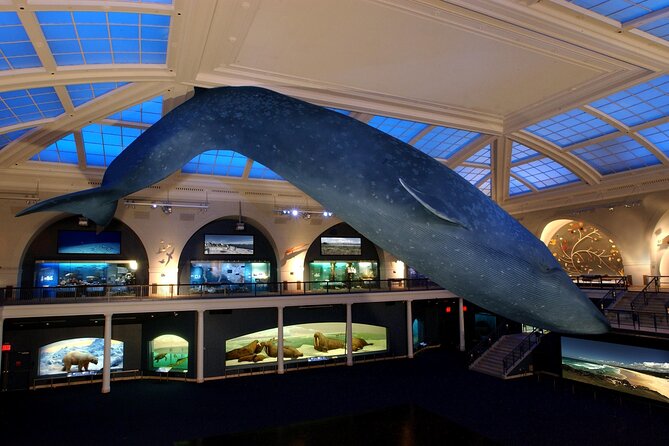
Not all of AMNH is living things and fossils. A big part of the included experience is the science side, especially:
- The Rose Center for Earth and Space
- The Richard Gilder Center for Science, Education, and Innovation
The value here is balance. You go from past life to Earth systems and then toward how science works. Even if you’re not a “space person,” this section helps you connect the museum’s universe story to the planet you’re standing on today.
For families, the science areas can be a strong second act. Kids often do better once they feel like the museum is answering questions they didn’t know how to ask. Adults also appreciate it, because it moves from “cool objects” into “how we learn.”
Small note to plan correctly: your general admission includes these centers, but some specific experiences inside may require extra tickets. So treat the science wing as part of your base plan, and treat any special show or ticketed add-on as optional.
What you might miss unless you plan for ticketed extras

General admission is big, but it is not everything. The museum notes that general admission does not include certain ticketed exhibitions and experiences such as:
- Invisible Worlds
- the butterfly vivarium
- the giant-screen film
- the Hayden Planetarium Space Show
This is the main “gotcha” for people who assume one admission means the entire museum program. The solution is simple: decide what your group really wants in advance.
If your group loves nature in action, you might care about the butterfly vivarium or giant-screen film. If your group is planetarium-first, you’ll want to price that separately and decide if it’s worth the extra cost for your schedule.
My advice: build your day around the included galleries first. Then, if there’s time and interest, add any ticketed extras at the end. That way, even if you run out of energy, you already covered the big included wins.
Pacing a 3 to 4 hour plan without feeling rushed
The ticket is associated with about 3 to 4 hours. That can work if you keep your priorities tight:
- Choose one “big dinosaur stop”
- Choose one “animal hall”
- Choose one “ocean scale moment”
- Add the science centers if time allows
But I’d be honest with you: AMNH can be more than one afternoon. Reviews and real-world experience around the museum suggest many people take longer because it’s a multi-level place and it’s packed with things that deserve more than a glance.
So here’s the best middle path:
- Start early.
- Hit one anchor exhibit early, before crowds thicken.
- Use the paper map to move in a straight line between major rooms.
- Take breaks in the included areas rather than trying to “power walk” through everything.
If you’re with strollers, the museum is generally manageable for ADA needs and stroller movement, but it’s still a lot of walking on hard floors. Wear shoes that don’t hate you by hour two.
Crowds, closed exhibits, and how to protect your day
AMNH can get busy quickly. If you’re hoping for a calm stroll and quiet looking time, timing matters. Even arriving earlier doesn’t guarantee empty rooms, but it usually helps you avoid the worst crush.
Another real-world possibility: some exhibits can be closed or partially closed for refurbishment. You can’t fully control that. But you can control your mindset and your plan. Instead of “seeing everything,” plan “seeing the top things that matter to us.”
Here’s how to do that with confidence:
- Pick your 3 must-sees and protect them.
- Keep a flexible backup list on your phone or highlighted on your paper map.
- Treat any closures as a reason to explore adjacent rooms rather than a personal failure.
Also, food is part of keeping energy up. The museum has dining options, and one note I liked is that the food court includes gluten free choices. That matters when you’re balancing kids, picky eaters, and a long day of walking.
Who this ticket fits best
This admission pass is a strong fit if you want:
- A full museum day without a guided tour script
- Multiple themes in one stop: dinosaurs, animals, oceans, and science
- A family-friendly option where kids and adults can both find “their thing”
It’s also a good choice for couples who like museums but don’t want to commit to an extra-ticket show right away. And if you’re traveling with school-age kids or teens, this is the kind of place where science doesn’t feel like homework.
If you hate lines and voucher exchanges frustrate you, then you’ll want to consider whether you’re okay with a ticket swap step. But if you’re flexible, the museum experience itself makes the hassle feel minor.
Should you book this AMNH admission ticket?
I’d book it if your priority is freedom to roam across the museum’s main included areas, and you’re happy to manage ticket exchange at the entrance. At $37, the value comes from access to 40+ permanent galleries plus two major science centers, and the big-hitters like the T. rex skeleton and the 29-meter blue whale model.
Skip the idea or rethink it if your plan is “we only want the special shows.” General admission does not include Invisible Worlds, the butterfly vivarium, the giant-screen film, or the Hayden Planetarium Space Show. In that case, you might want to price out those extras so you don’t feel surprised later.
If your goal is a memorable AMNH day with minimal planning stress, this is a practical way to get in and see the museum’s best work at your own pace.
FAQ
How long should I plan for at the American Museum of Natural History?
The admission ticket is associated with about 3 to 4 hours, but the museum is large. If you want time to really see things, plan on at least a few hours with flexibility.
What is included with general admission?
General admission includes access to more than 40 permanent exhibition galleries, plus the Rose Center for Earth and Space and the Richard Gilder Center for Science, Education, and Innovation.
What is not included in general admission?
General admission does not include ticketed exhibitions such as Invisible Worlds, the butterfly vivarium, the giant-screen film, and the Hayden Planetarium Space Show.
Do I need to exchange my voucher for a ticket?
Yes. You convert your voucher to an admission ticket when you arrive at the museum.
Is this admission ticket good for families and kids?
Yes, it’s described as family-friendly and suitable for kids. Children under 3 qualify for waived admission fees.
Is the museum easy to reach and can I get a map on site?
The museum is near public transportation. You can also get a paper map at museum entrances, information desks, and membership desks.
Can I cancel for a full refund?
Yes. You can cancel for free up to 24 hours before the experience start time for a full refund.
Historical Tours we have also been through in New York City
- New York City: American Museum of Natural History Ticket★ 4.5 · 15,447 reviews
- NYC: Starship Landmark 90 Minute Sightseeing Cruise★ 4.6 · 3,666 reviews
- Starship Landmark 90 Minute Sightseeing Cruise★ 4.5 · 2,073 reviews
- Top Rated Brooklyn Half-Day Food, History & Culture Tour via bus★ 5.0 · 758 reviews
- NYC: Speakeasy Drinks and Prohibition History Tour★ 4.7 · 474 reviews
Tickets: further reviews from New York City
- NYC: SUMMIT One Vanderbilt Tickets★ 4.7 · 51,195 reviews
- NYC: Empire State Building Tickets – Observatory & Museum★ 4.7 · 25,757 reviews
- New York City: American Museum of Natural History Ticket★ 4.5 · 15,447 reviews
- NYC: Museum of Modern Art (MoMA) Entry Ticket★ 4.6 · 12,540 reviews
- NYC: One World Observatory Skip-the-Line Ticket★ 4.7 · 12,329 reviews
Tour Reviews: more from our New York City desk
- NYC: SUMMIT One Vanderbilt Tickets★ 4.7 · 51,195 reviews
- NYC: Empire State Building Tickets – Observatory & Museum★ 4.7 · 25,757 reviews
- New York City: Statue of Liberty & Ellis Island with Ferry★ 4.6 · 18,683 reviews
- New York City: American Museum of Natural History Ticket★ 4.5 · 15,447 reviews
- Statue of Liberty and Ellis Island Tour: All Options★ 5.0 · 13,571 reviews
Newest New York City reviews added to this site
- NYC: Whitney Museum Ticket
★ 4.2 · 315 reviews - NYC: Manhattan & Statue of Liberty Cruise with Shuttle Bus
★ 4.6 · 316 reviews - 60-Minute Statue of Liberty Sightseeing Cruise
★ 3.0 · 317 reviews - True Crime New York: NYPD-Guided Mafia Walking Tour w/ Food
★ 4.6 · 318 reviews - New York City Cocoa and Carols Holiday Cruise
★ 4.5 · 318 reviews - Harlem Wednesday Morning Gospel Tour
★ 4.5 · 320 reviews - Central Park Bike Rental: Quality Bikes with Map, Helmet, Lock
★ 4.0 · 324 reviews - New York City Harlem Highlights w/ Gospel Concert & Transfer
★ 4.5 · 326 reviews - 9/11 Memorial Tour with Optional Museum and One World Access
★ 5.0 · 330 reviews - New York City Sunset Cruise on a Yacht
★ 5.0 · 331 reviews
Historical Tours, side by side.
 ★ 4.5New York City: American Museum of Natural History TicketFrom $3715,447 reviews
 ★ 5.0History and Hauntings of Salem Guided Walking TourFrom $3614,564 reviews
 ★ 5.0Charleston’s Old South Carriage Historic Horse & Carriage TourFrom $5010,023 reviews
 ★ 4.5Beneath The Streets Underground History TourFrom $298,006 reviews
 ★ 5.0Big Island in a Day: Volcanoes Waterfalls Sightseeing and HistoryFrom $2646,569 reviews
 ★ 5.0Boston: Freedom Trail History Small Group Walking TourFrom $356,450 reviews
 ★ 5.0Historic Charleston Guided Sightseeing Walking TourFrom $306,216 reviews
 ★ 4.6NYC: Starship Landmark 90 Minute Sightseeing CruiseFrom $343,666 reviews
This one is also listed in